Skip to content
STUDY THE 4 SEASONS
Art & poetry about the seasons.
— By Julie Hodos on August 29, 2024; Updated on September 27, 2025.
This post may contain affiliate links. Please refer to our disclosure policy.
What season are you in right now? Whether it’s the crisp days of fall, the chilly winds of winter, the blooming vibrancy of spring, or the warm glow of summer, there’s no wrong time to introduce your kiddo to the beauty of the seasons. The changing of the seasons offers a wonderful opportunity to teach young children about the passage of time, encourage observation of the world around them, and spark their creativity through books, art, and poetry about the seasons. Here I share how to create a meaningful and engaging seasonal learning experience for your kiddo using literature, poetry, and a fun tree-painting activity. Plus, you’ll find a free printable to bring it all together!
Table of Contents

Why Teach Seasons to Kiddos?
The cyclical nature of seasons is a perfect way to introduce young children to concepts like time, change, and patterns in nature. For kids, who are naturally curious and eager to explore, the seasons provide a tangible way to connect with the world. Watching leaves fall, feeling the warmth of summer, or noticing the first spring flowers can spark wonder and questions. By pairing these observations with books, poetry, and art, you’re not only teaching about seasons but also fostering language development, creativity, and critical thinking.
This activity is designed to be flexible for different ages and learning styles. Younger preschoolers (ages 2-3) will enjoy the sensory experience of finger painting and the rhythm of poetry, while older kiddos (ages 4-8) can dive deeper into discussions about seasonal changes and the imagery in poems. The combination of reading, creating, and reflecting makes this a rich, multi-sensory learning experience that is perfect for a homeschooling family or simply bonding time on the weekend.
Structuring the Seasons Lesson for Homeschool
I do this activity with my boys every fall and each time they love it. The poetry is familiar to them because we recite poetry frequently in our home. My eldest has Summer Sun by Robert Louis Stevenson memorized now and my middle kiddo has the first stanza down pat. The act of bringing together a favorite art activity with the poetry they hear recited almost daily is why I think they like this lesson so much. This doesn’t include the fact that the everchanging world around them is being explained to them in an interactive and beautiful way.

Step 1: Set the Stage with Books About the Seasons
Before diving into poetry and art, start by reading books that introduce the concept of seasons. Books are a fantastic way to build background knowledge and spark curiosity. Choose age-appropriate titles that capture the beauty and characteristics of each season. Here are some recommendations for different age groups:
Books for Preschoolers (Ages 2-5)
- Old Bear by Kevin Henkes: This charming story follows a bear who dreams of the seasons while hibernating. The simple text and vibrant illustrations make it perfect for young children.
- Tree: Seasons Come, Seasons Go by Patricia Hegarty: This beautifully illustrated book follows a tree through the seasons, with rhyming text that captivates young readers.
Books for Older Kiddos (Ages 4-8)
- Four Seasons Make a Year by Anne Rockwell: This book explains the characteristics of each season in a clear, engaging way, perfect for sparking discussion.
- The Reasons for Seasons by Gail Gibbons: A nonfiction favorite, this book dives into the science behind seasons, making it ideal for curious older kiddos.
- The Seasons of Arnold’s Apple Tree by Gail Gibbons: another favorite of this author, the book follows a boy named Arnold as he observes his tree changing throughout a year.
Read Next: 40+ Best Books About the Seasons
How to Use Books in the Lesson
Read one or two books to start the activity, depending on your child’s attention span. For younger children, focus on the pictures and simple descriptions of seasonal changes. Point out details like snow in winter or flowers in spring. For older children, ask questions like, “What do you notice about the trees in this season?” or “What do you like to do in summer?” This sets the stage for the poetry and art activities by building a shared understanding of the seasons.
If you’re homeschooling, consider reading one book each day of the week to spread out the learning. For example, read Old Bear on Monday, Tree: Seasons Come, Seasons Go on Tuesday, and so on. This approach keeps the activity fresh and allows time for discussion and reflection. However, if your young kiddos want the same book about seasons to be read again and again, do it! I know I frequently have several topical books chosen but my kiddos latch onto one they want to hear repeatedly.

Step 2: Gather Materials for the Art Activity
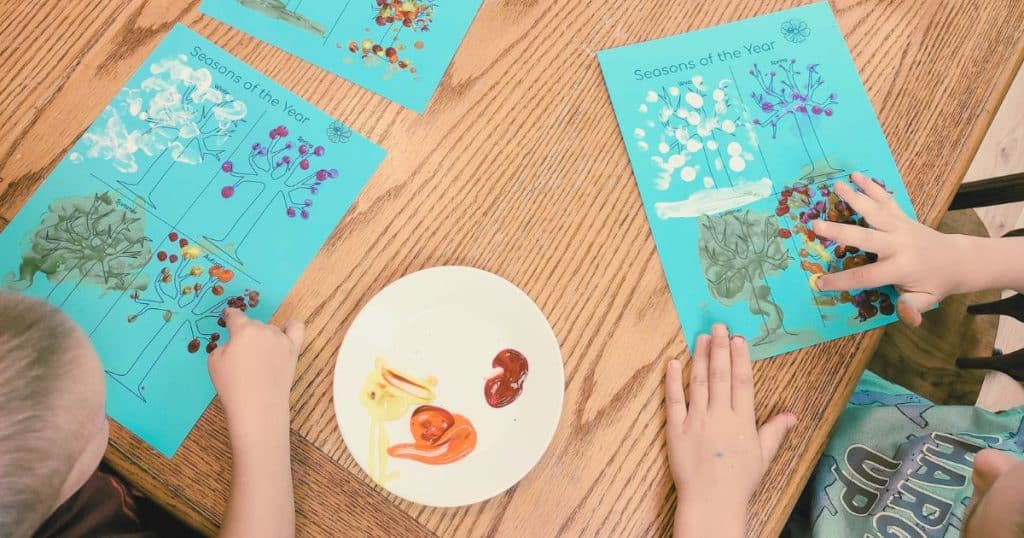
The core of this lesson is a finger-painting activity where your child will create four trees, each representing a different season. The free printable, available at the bottom of this post, features four tree outlines that your child will decorate with paint to reflect winter, spring, summer, and fall. Here’s how to prepare:
Materials Needed
- Free Printable: Download the four-tree printable from the link at the end of this post. For a polished look, print it on pastel blue cardstock or a cream. This adds a nice background for the seasonal trees and lets the white snow pop!
- Paints: Use tempera paint, which is washable and safe for young children. You’ll need:
- White (for winter snowflakes)
- Pink (for spring blossoms)
- Green (for summer leaves)
- Red, orange, and yellow (for fall leaves)
- Small Plates: Use small plates or palettes to hold each individual paint color. This prevents mixing and makes it easier to switch between seasons.
- Paper Towels: Keep these handy for cleaning fingers between colors.
- Poetry Books or Printouts: Select poems about the seasons (listed below) and have them ready to read. Mark the pages in your poetry books or print the poems for easy reference.
Read Next: 7 Types of Paint for Art
Pro Tips for Preparation
- Print on Cardstock: The pastel blue cardstock adds a professional touch and holds up well to finger painting. If you don’t have cardstock, regular paper works fine, but be gentle with the paint to avoid tearing.
- Use Tempera Paint: Tempera is non-toxic and washes off easily, so you don’t need to worry about stains on clothes or furniture.
- No Paintbrushes Needed: This activity uses finger painting to keep it simple and sensory-focused. It’s also great for fine motor development!
- Prep Poetry in Advance: Bookmark the poems or print them out so you can read them smoothly during the activity. Reading the poems while your child paints helps connect the art to the imagery in the poetry.

Step 3: Set Up the Painting Station
Create a calm, inviting painting station to make the activity enjoyable. Here’s how to set it up:
- Lay Out the Printable: Place the four-tree printable on a flat surface.
- Organize the Paints: Put a small amount of each paint color on separate small plates. Start with white paint for winter, as it’s the first season in the activity.
- Provide Paper Towels: Have a stack of paper towels nearby for quick finger cleanups between seasons.
- Set the Mood: Play soft background music or keep the environment calm to help your child focus. You might even talk about the current season (Such as, “It’s fall right now, so we’ll see colorful leaves outside!”).
Once everything is ready, bring your child to the table and explain that they’ll be painting trees to show how they change with each season. Demonstrate the finger-painting technique: dip a fingertip in paint, press it gently onto the paper, and lift straight up to create a distinct mark (like a snowflake, blossom, or leaf). Emphasize that smearing is okay, especially for winter, but you’re aiming for individual marks for the other seasons. The first time each of my boys have participated in this activity they always end up smearing something. I always correct them but keep it light because we don’t want to lessen their eagerness.
Step 4: Dive Into Poetry and Painting
Now it’s time to combine poetry and art! For each season, you’ll read a poem, discuss its imagery, and guide your child through painting their tree. Below, I’ve selected poems that I think vividly capture the season. Each poem is paired with specific painting instructions to bring the season to life.

Winter: When the Earth Rests
Poem: Winter-Time by Robert Louis Stevenson (from A Child’s Garden of Verses)
Late lies the wintry sun a-bed,
A frosty, fiery sleepy-head;
Blinks but an hour or two; and then,
A blood-red orange, sets again.Before the stars have left the skies,
At morning in the dark I rise;
And shivering in my nakedness,
By the cold candle, bathe and dress.Close by the jolly fire I sit
To warm my frozen bones a bit;
Or with a reindeer-sled, explore
The colder countries round the door.When to go out, my nurse doth wrap
Me in my comforter and cap;
The cold wind burns my face, and blows
Its frosty pepper up my nose.Black are my steps on silver sod;
Thick blows my frosty breath abroad;
And tree and house, and hill and lake,
Are frosted like a wedding-cake.
Painting Instructions:
- What to Paint: In winter, deciduous trees are bare, so the winter tree will have no leaves. Instead, your child will use white paint to create snowflakes around the tree.
- How to Paint: Show your child how to dip their fingertip in white paint, press it gently onto the paper, and lift straight up to make a snowflake. Encourage them to scatter snowflakes around the tree, not on the branches. If they smear the paint, that’s okay—it can look like swirling snow! This is also why I always recommend beginning with winter.
- Discussion Prompts:
- For younger children: “What does snow feel like? Have you seen snow before?”
- For older children: “What do you think ‘frosted like a wedding-cake’ means? Can you imagine a lake covered in frost?”
- Tips: Start with winter because smearing isn’t a big issue here. Wipe fingers clean before moving to the next season.
Once the winter tree is complete, switch to the pink paint for spring.

Spring: When the Earth Awakes
Poem: Spring by William Blake (from Songs of Innocence and of Experience)
Sound the flute!
Now it’s mute!
Birds delight,
Day and night,
Nightingale,
In the dale,
Lark in sky, –
Merrily,
Merrily, merrily to welcome in the year.Little boy,
Full of joy;
Little girl,
Sweet and small;
Cock does crow,
So do you;
Merry voice,
Infant noise;
Merrily, merrily to welcome in the year.Little lamb,
Here I am;
Come and lick
My white neck;
Let me pull
Your soft wool;
Let me kiss
Your soft face;
Merrily, merrily we welcome in the year.
Painting Instructions:
- What to Paint: In spring, trees bloom with delicate blossoms. Your child will use pink paint to create blossoms on the tree’s branches.
- How to Paint: Demonstrate dipping a fingertip in pink paint and pressing it onto the branches to make blossoms. Encourage them to stay on the canopy (the upper branches) where blossoms grow. Lift straight up to create distinct marks.
- Discussion Prompts:
- For younger children: “What colors do you see on trees in spring? Have you smelled flowers before?”
- For older children: “Why do you think the poem says ‘merrily’ so many times? How does spring make you feel?”
- Tips: Guide your child to focus on the branches to keep the painting realistic. Clean fingers before moving to summer.
Switch to green paint for the summer tree.

Summer: When the Earth Showcases Her Beauty
Poem: Summer Sun by Robert Louis Stevenson (from A Child’s Garden of Verses)
Great is the sun, and wide he goes
Through empty heaven without repose;
And in the blue and glowing days
More thick than rain he showers his rays.Though closer still the blinds we pull
To keep the shady parlour cool,
Yet he will find a chink or two
To slip his golden fingers through.The dusty attic spider-clad
He, through the keyhole, maketh glad;
And through the broken edge of tiles,
Into the laddered hayloft smiles.Meantime his golden face around
He bares to all the garden ground
And sheds a warm and glittering look
Among the ivy’s inmost nook.Above the hills, along the blue,
Round the bright air with footing true,
To please the child, to paint the rose,
The gardener of the World, he goes.
Painting Instructions:
- What to Paint: Summer trees are lush with green leaves. Your child will use green paint to create a full, vibrant canopy.
- How to Paint: Encourage generous use of green paint on the branches to show a thick canopy. Press and lift to create individual leaves, filling the upper part of the tree.
- Discussion Prompts:
- For younger children: “What do you like to do in summer? Do trees look different in summer?”
- For older children: “The poem talks about the sun’s ‘golden fingers.’ What do you think that means?”
- Tips: Give your child plenty of time to fill the canopy, as summer trees are dense. Clean fingers before moving to fall.
Bring out the red, orange, and yellow paints for the fall tree.

Fall: When the Earth Adorns Herself in Warm Hues
Poem: Autumn by Emily Dickinson (from The Illustrated Treasury of Poetry for Children, edited by David Ross)
The morns are meeker than they were,
The nuts are getting brown;
The berry’s cheek is plumper,
The rose is out of town.
The maple wears a gayer scarf,
The field a scarlet gown.
Lest I should be old-fashioned,
I’ll put a trinket on.
Painting Instructions:
- What to Paint: In fall, leaves turn vibrant colors and some fall to the ground. Your child will use red, orange, and yellow paint to create a colorful canopy and leaves on the ground.
- How to Paint: Have your child press and lift to create leaves on the branches and scatter some below the tree to show falling leaves. They can also add a few leaves fluttering between the branches and ground.
- Discussion Prompts:
- For younger children: “What colors do you see in fall? Have you jumped in a pile of leaves?”
- For older children: “Why does the poem say the maple wears a ‘gayer scarf’? What’s changing in the fall?”
- Tips: Encourage mixing colors for a realistic effect. Let your child experiment with where the leaves fall.
Step 5: Reflect and Discuss the Seasons
Once all four trees are painted, take a moment to admire your child’s artwork and talk about the seasons. Explain that seasons are cyclical—after fall comes winter, and the cycle repeats. Here are some ways to extend the conversation:
- For Younger Children:
- “Which season do you like best? Why?”
- “What happens to the trees after fall?”
- Point to each tree and ask, “What’s happening in this season?”
- For Older Children:
- “What’s different about the trees in each season? Why do they change?”
- “Can you think of a holiday or event that happens in each season?”
- “How do the poems make you feel about each season?”
Hang the finished artwork on the fridge or a bulletin board. Revisit it throughout the year as the seasons change, asking your child to describe what they see outside and compare it to their painting. This reinforces the concept of cycles and validates their creative work.
Step 6: Extend the Learning
To deepen your child’s understanding of the seasons, try these additional activities:
- Nature Walk: Take a walk outside and look for signs of the current season.
- Seasonal Chart: Create a chart with your child to track seasonal changes, like temperature, clothing, or activities. Add drawings or stickers for each season.
- More Poetry: Read additional poems, such as:
- The Months or A Calendar by Sara Coleridge for a year-round overview.
- Doubleday’s Favorite Poems Old and New Selected by Helen Ferris. With an entire section dedicated to the calendar year (and many more topics), this book is difficult to go wrong with.
- Science Connection: For older kiddos, talk about why seasons happen (the Earth’s tilt and orbit). Use a globe or a simple diagram to show how sunlight changes.
- Seasonal Crafts: Try leaf rubbings, snowflake cutting, or flower pressing to complement the painting activity and the season you are in.
Free Printable and Additional Resources
Grab the free four-tree printable to start this activity! For more leaf-themed activities, check out Ll is for Leaves unit, which includes additional art projects, book recommendations, and hands-on learning ideas.
Tips for Homeschooling Parents
- Keep It Flexible: If your child isn’t interested in painting all four trees in one sitting, spread the activity over a few days. For example, do winter and spring one day, then summer and fall the next.
- Encourage Observation: Throughout the year, point out seasonal changes during daily routines, like driving to the park or looking out the window.
- Celebrate Creativity: Praise your child’s unique approach to the painting, even if it’s not perfect. The goal is to spark joy and curiosity, not to create a masterpiece.
- Store Artwork Thoughtfully: Check out this post on Artwork Storage Solutions.

Why This Activity Works
Combining books, poetry, and art creates a multi-sensory experience that engages preschoolers on multiple levels. The books provide context, the poetry introduces beautiful language and imagery, and the painting lets children express their understanding creatively. This activity also builds fine motor skills, encourages observation, and fosters a love for God’s creation and literature.
By revisiting the artwork throughout the year, you’re helping your child make connections between their creations and the world around them. Whether you’re a homeschooling parent or simply looking for a fun family activity, this seasons lesson is a memorable way to teach your preschooler about the beauty of change.
What’s your favorite season to explore with your child? Share your thoughts or questions in the comments below!
Recent Posts on the Homeschool Blog