Skip to content
FLASHLIGHTS & MORE
Nocturnal animal activities for kids.
— By Julie Hodos on October 4, 2024; Updated on October 8, 2025.

This post may contain affiliate links. Please refer to our disclosure policy.
Get ready to spark your preschooler’s curiosity with nocturnal animal activities that turn the mysteries of the night into a playground of learning. Ever wonder what creatures are prowling while we sleep? From bats soaring through the skies, to owls hooting in the trees, to rats scurrying in the weeds, nocturnal animals are a fascinating topic for young explorers.
Here, we’ll dive into why kids should learn about these nighttime critters, share must-read books, uncover fun facts, offer hands-on activities, and spotlight a favorite flashlight activity inspired by a charming wordless book. Perfect for homeschoolers or weekend adventurers, these ideas are simple, engaging, and packed with wonder. Let’s light up the night!
Table of Contents

Why Kids Should Learn About Nocturnal Animals
Learning about nocturnal animals isn’t just about memorizing facts—it’s about opening up a whole new perspective on the world. Kids are naturally diurnal, meaning they’re active during the day and rest at night. But introducing them to nocturnal creatures helps them understand that not every living thing follows the same schedule. This builds empathy and appreciation for biodiversity right from a young age.
First off, it sparks wonder and reduces fear of the dark. Many preschoolers have bedtime anxieties because the night feels unknown and a bit scary. By talking about how animals like foxes or raccoons thrive in the darkness, we demystify it. Kids start to see the night as a busy, vibrant time rather than something to dread. My own boys are still hesitant to go out in the dark or not have their closet light on but since doing some nocturnal animal activities with them they’ll venture out into the night with a flashlight or a parent to explore. These activities piqued their curiosity in a healthy way and now they’re excited about what might be happening outside their windows.
Practically speaking, this topic ties into science education seamlessly. It introduces concepts like adaptations—think about how owls have super-sharp hearing or how bats use echolocation to navigate in the pitch black. These lessons lay the groundwork for biology without feeling like a lecture. Plus, it’s a great way to encourage outdoor exploration, even if it’s just in your backyard at dusk. In a world where screen time can dominate, getting kids outside to observe real nature boosts their physical health, sharpens observation skills, and fosters a love for the environment.
Emotionally and socially, learning about nocturnal animals promotes inclusivity. Just as some animals are night owls (pun intended!), people have different rhythms too—think night-shift workers or cultures with evening traditions. This helps kids appreciate differences. And let’s not forget the creativity boost: Imagining a raccoon’s midnight snack raid or a hedgehog’s nocturnal wanderings inspires storytelling, art, and pretend play.
Overall, these lessons make kids more curious lifelong learners. Studies show that early exposure to nature themes improves problem-solving and attention spans. So, whether you’re homeschooling or just looking for weekend fun, nocturnal animal activities are a win-win. They turn bedtime into an opportunity for bonding and discovery, helping kids feel connected to the bigger world around them.
Read Next: Diurnal vs. Nocturnal Animal Activities
Fun Facts About Nocturnal Animals
Nocturnal animals are full of surprises, and sharing these tidbits with kids can make learning even more exciting. Here are some fascinating facts to sprinkle into your activities or bedtime chats.
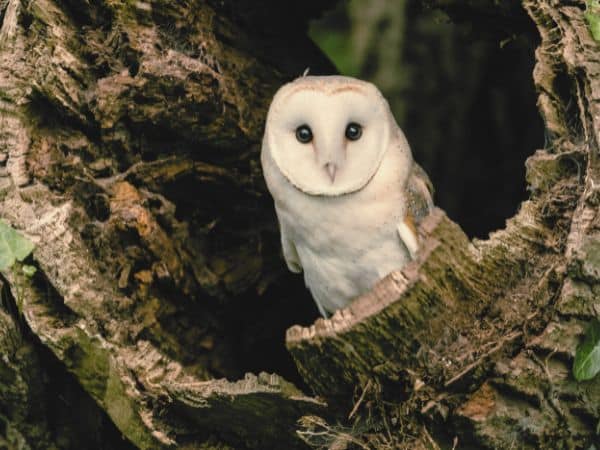
- Did you know that owls can turn their heads up to 270 degrees? Their necks have extra vertebrae, letting them swivel without moving their bodies, which helps them spot prey in the dark.
- Bats aren’t just cool for echolocation—they’re also pollinators! Some species, like fruit bats, help plants grow by spreading pollen at night, just like bees do during the day. The fact that some flowers only bloom at night (like in the desert or tropical areas) blew my boys’ minds…and mine!
- Fireflies use their glow not just to look pretty but to talk to each other. Their flashes are like a secret code for finding mates. If you watch closely, different species have unique flash patterns.
- Raccoons are super smart and have nimble paws that act almost like human hands. They can open latches or dig through trash cans, which is why they’re such expert scavengers at night.
- Hedgehogs are immune to some snake venom, which helps them hunt at night without worry. They also roll into a spiky ball to stay safe.
These facts add a layer of wonder to any activity, making kids eager to learn more about the nighttime world.
Read Next: Diurnal and Nocturnal Animals (Coming soon!)
Books on Nocturnal Animals for Kids
Books are my go-to for kicking off any theme, and nocturnal animals have some real gems. They’re a gentle way to introduce facts while fueling imagination. Here are a few favorites that I’ve used with my kiddos—wordless ones for early readers, and simple stories for cozy read-alouds.
Flashlight by Lizi Boyd is a wordless picture book that follows a little boy on a nighttime camping adventure, using his flashlight to spot creatures like bats, skunks, and foxes. The illustrations are whimsical and detailed, perfect for sparking discussions about nocturnal life. My kids love “reading” it themselves, pointing out animals and making up their own stories.
Daytime Nighttime, All Through the Year by Diane Lang is a vibrant, engaging picture book that explores the contrasting lives of diurnal and nocturnal animals across the seasons. With lively text and colorful illustrations by Andrea Gabriel, it highlights creatures like butterflies basking in daylight and owls hunting under moonlight, month by month. It’s a great pick for introducing nocturnal animal activities and sparking curiosity about nature’s rhythms.
The Barn Owls by Tony Johnston is a gem that celebrates the quiet lives of barn owls nesting in a redwood barn for generations. With lyrical text and Deborah Kogan Ray’s warm watercolor illustrations, it follows the owls’ nocturnal hunts and daytime rest amid whispering wheat. This soothing read-aloud blends nature, science, and wonder, making it ideal for bedtime or exploring nocturnal animal activities.
Where Are the Night Animals? by Mary Ann Fraser dives into habitats, showing how animals like coyotes and fireflies come alive at dusk. It’s part of the Let’s-Read-and-Find-Out Science series, so it blends story with real info, complete with activities in the back.
These books are affordable and often available at libraries. The Daytime Nighttime, All Through the Year is the only one that is difficult to come by, I would start at the library but secondhand books are always a great way to expand your library (that’s how we do it!). Start with one or two books, and watch how they inspire your nocturnal animal activities!
10 Nocturnal Animal Activities
Now for the hands-on fun! I’ve curated 10 nocturnal animal activities that are easy to set up, use everyday items, and keep preschoolers engaged. Each one builds on the nocturnal theme, encouraging learning through play. I’ve kept them practical—no fancy supplies needed—and focused on safety for little ones.

Owl Pellet Exploration
If you’re up for a bit of mess. Get safe, sterilized owl pellets online. Kids use tweezers to dissect them and find tiny bones from the owl’s prey. It’s gross but so much fun that teaches about food chains and nocturnal hunting. Start with a book like The Barn Owls to set the scene, and always supervise to keep it hygienic.
Flashlight Stuffie Hunting
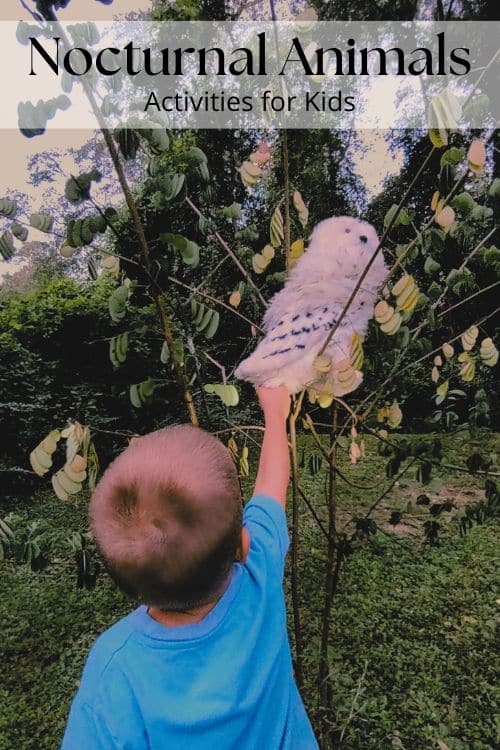
I won’t go into too much detail since this is the highlight activity, but my boys love this. I enjoy how easy it is to set up and the joy it brings my boys. Their confidence to explore the night during this activity makes it worth setting up for an active fall evening.
Nocturnal Sound Safari
Start a nocturnal sound safari by turning your living room into a nighttime jungle. Play audio clips of nocturnal animal sounds (free apps or YouTube have great ones). Dim the lights and have kids guess the animal—owl hoots, cricket chirps, or fox calls. It’s a sensory experience that hones listening skills and makes abstract concepts real. We do this in the evening during fall or winter when it gets dark sooner, and my boys love mimicking the sounds afterward.

Bat Echolocation
Play a bat echo game to explain echolocation simply—bats “see” with sound. Have one child be the bat, blindfolded, making clicking noises, while others echo back if they’re close. Use pillows for safe boundaries. This activity builds spatial awareness and empathy for how nocturnal animals navigate darkness.
Shadow Puppets
Create nocturnal animal shadow puppets by cutting out simple animal shapes (bats, moths, raccoons) from black paper and taping them to sticks. Shine a flashlight on a wall or sheet to create shadows, and act out nighttime stories. Kids learn about silhouettes and light play while practicing storytelling. We reuse the puppets again and again because the boys love it!
Firefly Jar Craft
Make a firefly jar craft to mimic how nocturnal insects like fireflies glow in the dark. Decorate jars with glow-in-the-dark paint or stickers. Discuss how bioluminescence helps animals at night. This craft doubles as a nightlight, helping ease bedtime fears with a personal touch.
Moth Moon Watching
Try moth moon watching on a clear night. Sit outside with a white sheet and flashlight to attract moths. Observe their wings and discuss pollination at night. It’s a real-world science lesson on nocturnal insects. If bugs aren’t your thing, use pictures, but the live version creates lasting memories.
Read Next: What is an Insect for Kids

Raccoon Scavenger Hunt
Set up a raccoon scavenger hunt by hiding small treats or toys around a dim room, mimicking a raccoon’s foraging. Give kids a small basket and flashlight to search. It teaches about opportunistic nocturnal feeders and encourages problem-solving. Keep it indoors for safety.
Fox Den
Create a fox den building activity using blankets, pillows, and boxes to build a cozy den where kids pretend to be foxes resting by day and hunting by night. Role-play scenarios like sneaking for food. This fosters imagination and understanding of diurnal-nocturnal cycles, plus it’s a sneaky way to practice sharing space.
Nocturnal Animal Yoga
Practice nocturnal animal yoga by adapting poses to animals—bat hang (forward bend), owl twist (seated twist), or skunk spray (child’s pose with a giggle). Do it in low light for atmosphere. It promotes mindfulness, body awareness, and ties physical movement to learning about adaptations. I love this video from Ironstone Wellbeing Centre, just follow the link above to be doing yoga with your little one.
These activities are flexible—adapt them to your space and child’s energy. They’re all about making nocturnal animals relatable and exciting!

The Flashlight Hunting Activity: Why It’s Great and How to Do It
Why the Activity and Book Are Great
The flashlight activity, inspired by Flashlight by Lizi Boyd, stands out as a superstar in our nocturnal animal activities lineup. Why is it so great? For starters, it’s incredibly simple yet profoundly engaging, blending storytelling, exploration, and a touch of magic. The book itself is a wordless wonder, allowing kids to interpret the illustrations in their own way, which builds narrative skills and confidence in reading without words. It introduces nocturnal versus diurnal concepts gently through the little boy’s adventure, highlighting common night prowlers like bats, skunks, raccoons, foxes, mice, and deer.
Practically, the activity requires minimal prep and uses items you likely already have, making it ideal for busy parents. It’s educational too—kids learn about animal behaviors while practicing observation and fine motor skills with the flashlight. Emotionally, it turns darkness into a playground, reducing fears and building excitement for nature. My boys request it repeatedly because it feels like a real treasure hunt, and it ties perfectly into broader themes like camping or wildlife appreciation. If you’re looking for a low-effort, high-reward way to dive into nocturnal animal activities, this one’s a gem.

How to Do the Flashlight Activity
Animals that hunt and feed at night and sleep during the day are called nocturnal animals. On the other hand, ones that are active during the day and slumber at night are diurnal. Nocturnal animals can be especially fascinating to children since they themselves are diurnal creatures. Unlike nocturnal animals, children’s bodies have not adapted to help them survive in the dark, so the night still holds many mysteries. The book and activity today will not only reveal some of the mysterious midnight prowlers but also remove some of the mystery the darkness holds.
Chances are your child has some stuffed animals lying around. Stuffies, flashlights, and the darkness of night are all the materials you need for this activity. You can also use small animal figures, but I’ve found they aren’t as exciting for my boys. Also, do what you can to get your hands on Flashlight by Lizi Boyd. It was one of the first wordless books we had in our homeschool, and my boys are always eager to read it and go exploring with the little boy.
Flashlight by Lizi Boyd is a nighttime adventure of a little boy who is camping. Struggling to read his book and hold his flashlight at the same time, he decides to hunt for a late-night snack in the woods. On his adventure, his flashlight discovers many creatures who are active as well. From bats to skunks to raccoons and foxes, the little boy makes his way through the woods to find an apple tree where he munches on an apple with some mice and deer nearby. Once he finishes, he has an accident and drops his flashlight!
But now it’s the animals’ turn to play with the flashlight. By the end, the little boy has even had his problem with holding his flashlight while reading resolved. A whimsical story like this, that is also educational, deserves a play-based learning opportunity. This is an easy activity and perfect to do as the days grow shorter.
Once night falls, distract your child by having them color at the table, play in their room, or have another adult entertain them. Discreetly take their stuffies outside and place them throughout the yard. I enjoy setting up scenes with the stuffed animals. For instance, I’ve set them up at the swing set with two stuffies enjoying conversation in a couple of lawn chairs while the others slid down the slide or perched at the top.

When I was asked to set them up again, I placed them in our front yard like they were checking the mail. This worked out well because my boys weren’t expecting the stuffies to not be in the backyard and ran around for a few minutes unable to find any of them. I eventually gave them the hint that their stuffies might be checking the mail, and the boys ran whooping to the front yard. If you want to hang a stuffed animal on a fence or doorknob, have a rubber band handy and loop it around their hands.
Now that the scene is set, read the book with your child. Then, ask them if they want to go outside and see if they can find any animals just like the little boy. Give your child a flashlight and go outside with them. My kiddos were pleasantly surprised to find that their stuffies were waiting for them in the yard. They eagerly ran around searching for them with their flashlight.
Your child will inevitably want to do this activity again and again. With it already being a late activity, you’ll need to decide based on how tired your child is. I’ll save this activity for when my kiddo has taken a late afternoon nap, usually by accident, and I know they’ll be up late anyway.
That’s all there is to it. Easy setup and no cleanup make this a perfect nighttime activity for a preschooler. This book would also be an excellent read leading up to a camping adventure as a family, but this activity is a great alternative to taking your child camping if they aren’t quite ready for that. If you enjoy more activities based on books, check out Send Hearts by Mail. Based on the book The Day it Rained Hearts by Felicia Bond, your child will be inspired to let others know they are loved. And it also helps clear out some of those random crafting supplies you’ve accumulated. Check it out at the link.

Explore the Night
There you have it—a deep dive into nocturnal animal activities that’s sure to light up your family’s evenings! From understanding why these lessons matter to exploring fun facts, books, and hands-on play, we’ve covered ways to make learning practical and joyful. Remember, the key is keeping it light-hearted—kids learn best when they’re having fun.
Thanks for reading, and happy exploring the night! If you try any of these nocturnal animal activities, leave a comment and tips below—I’d love to hear how it goes as would others!
Flashlight Hunting
AT A GLANCE ACTIVITY INSTRUCTIONS
Materials
- Flashlight
- Stuffed animals (nocturnal preferred)
Instructions
- When your child is busy, take the stuffed animals and place them in the backyard in random but easy to find areas.
- I love setting a scene, like having the animals on the swing set and going down the slide. Or sitting in lawn chairs around a campfire pit.
- Once placed and after dark, bring your child outside with a flashlight and tell them to find their toys.
- They’ll love finding their stuffed animals everywhere and will want to do it again and again. So be prepared to place the animals a few more times.
Recent Posts on the Homeschool Blog