Skip to content
OODLES OF NOODLES
Pasta for kids that will inspire and educate.
— By Julie Hodos on October 12, 2024; Updated on December 31, 2025.
This post may contain affiliate links. Please refer to our disclosure policy.
If you’re looking for an inexpensive, endlessly versatile material that keeps kids busy for hours, grabs a giant box of pasta and get ready to fall in love. Pasta is the ultimate open-ended play supply — it’s perfect for art projects, fine motor practice, science experiments, math games, and even real cooking. Whether your kids are 2 or 12, there’s a pasta activity here they’ll ask to do again and again. Grab your aprons and let’s turn ordinary noodles into extraordinary learning adventures!
Table of Contents

Why Pasta Activities Are Pure Magic for Kids
If you’ve ever stood in the grocery aisle staring at a wall of 49-cent pasta boxes wondering, “Could this actually be school?”—the answer is a thousand times yes. Pasta isn’t just food. It’s the Swiss Army knife of childhood development, the ultimate boredom-buster, and the one material that scales perfectly from drooling babies to eye-rolling teenagers. Here’s why pasta deserves its own shelf in your homeschool heart (and pantry).
- A box of pasta costs less than a coffee, lasts forever on the shelf, and can survive being dumped, dyed, glued, and cooked. You can hand your kids a $2 box of rigatoni and a piece of yarn and watch real learning explode. No fancy curriculum required.
- Every Age, Every Stage, Every Mood
- 3-year-old? Sorts rainbow pasta from cup to cup for 45 blissful minutes while you drink coffee in peace.
- 6-year-old? Engineers a 3-foot spaghetti tower that collapses in glorious slow motion.
- 10-year-old? Makes ricotta ravioli from scratch and brags about it for weeks.
- It Hits Every Single Learning Domain—Without Trying
- Physical: Pinching orzo, rolling dough, threading penne, crimping ravioli edges = fine motor training.
- Sensory: Crunchy dry, slimy cooked, colorful dyed. Every sense is invited to the party.
- Cognitive: Sorting shapes, patterning necklaces, counting to 100 with pastina, fractions with lasagna sheets—math and logic sneak in while they play.
- Language: New words (farfalle, orecchiette, linguine), sequencing recipes, describing textures during taste tests.
- Social-emotional: Pride from wearing a necklace they made, resilience when the tower falls, joy of cooking dinner for the family.
- Creative: Literally zero limits. Pasta becomes skeletons, mosaics, jewelry, musical instruments, or dinosaur food.
- Plain pasta at the end of the day? Cook it for dinner. Dyed pasta? It keeps for years in zip bags. Even the broken bits go into sound shakers or the chicken coop as treats. My kids have eaten their own homework more times than I can count, and they think it’s the coolest thing ever.
- One afternoon of making ravioli teaches measuring, patience, following multi-step directions, cleaning as you go, and the satisfaction of feeding people you love. My five-year-old loves helping make dinner on pasta night.
- Something about the repetitive motion of pouring, threading, or sorting tiny pasta quiets busy brains. I’ve watched kids who can’t sit still for a five-minute worksheet spend an hour silently transferring orzo with tweezers.
- Yes, there will be flour clouds and rogue wheels under the couch for weeks. But there will also be the week your four-year-old gifted numerous pasta necklaces to friends at church.
- Pasta opens the door to Italy, China, Japan, Thailand—suddenly you’re listening to opera while rolling dough, or using chopsticks to eat your rice noodles. Geography, history, and dinner become one delicious lesson.
- When you dump a bin of rainbow pasta on the table and say, “Go wild,” you instantly become the fun parent. When they eat the ravioli they made and declare it the best dinner ever? You win parenting for the week.
Bottom line: Pasta isn’t just an activity. It’s joy in a box, creativity in a bag, curriculum in a colander.
So the next time you’re tempted to overthink your lesson plans, remember: somewhere in your pantry is a humble box of noodles just waiting to become childhood magic. Go get it. Your kids (and your future self) will thank you.

Pasta-Themed Books Your Kids Will Love
Strega Nona by Tomie de Paola – The classic tale of the magic pasta pot that never stops cooking is pure joy and the perfect read-aloud before any pasta day.
More Spaghetti, I Say! by Rita Golden Gelman – A hilarious monkey refuses to stop eating spaghetti in this silly, rhythmic favorite that toddlers adore.
Cloudy With a Chance of Meatballs by Judi Barrett – When food falls from the sky (including spaghetti and meatballs!), imaginations run wild. Great for creative writing prompts afterward.
25+ Hands-On Pasta Activities for Kids
Sensory Pasta Play (Ages 1–6)
Classic Rainbow Pasta Sensory Bin
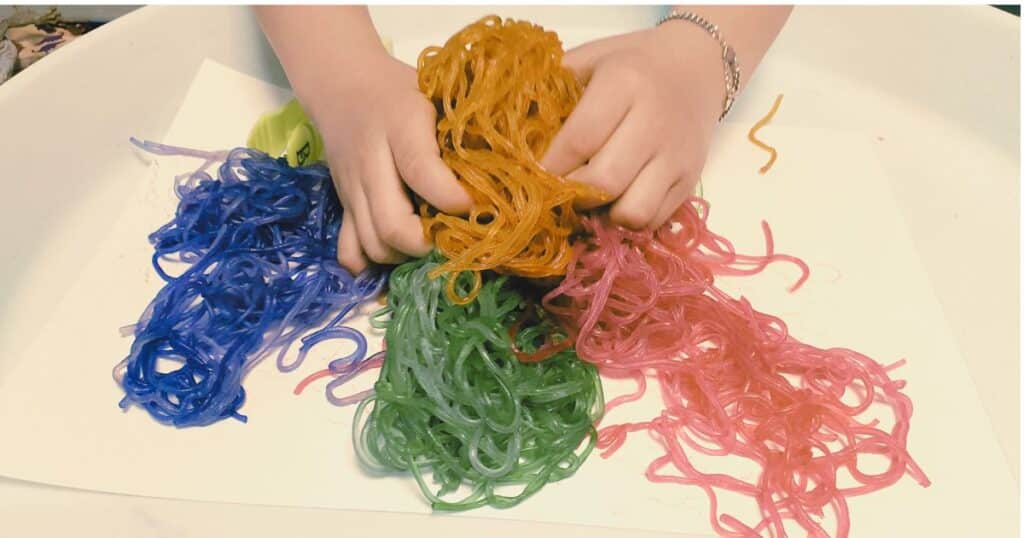
Fill a large bin with vibrant, dyed pasta in every color and add scoops, measuring cups, funnels, and small toys to bury. Children will happily pour, fill, dump, and dig for hours, completely absorbed in the crunchy textures and bright colors. This is the activity that turns “I’m bored” into “just five more minutes!” Learning opportunity: sensory integration, volume concepts, color recognition, and independent play skills.
Sound Shakers Discovery Bottles
Fill clear plastic bottles with different types and amounts of dry pasta, seal tightly with hot glue, and let kids shake, rattle, and compare the sounds. They love guessing which bottle has the orzo rain or the rigatoni thunder. These become permanent instruments in your music basket. Learning opportunity: sound exploration, volume and pitch concepts, and cause-and-effect.
Scented Cloud Dough + Pasta Treasures
Mix 8 cups flour with 1 cup baby oil (add peppermint or lavender essential oil if you like), then bury dyed pasta shapes like hidden gems. Children dig, mold, sift, and discover treasures for hours in this soft, moldable, heavenly-smelling dough. Learning opportunity: sensory integration, imaginative play, and scent-memory connections.

Fine Motor & Practical Life (Ages 2–8)
Pasta Threading Necklaces & Bracelets
Tape one end of yarn to make a firm “needle” and let kids thread tube pasta in patterns to create wearable jewelry. They proudly wear their creations all day and may even make more to share—zero waste, maximum pride. Learning opportunity: pincer grasp, bilateral coordination, patterning, and sequencing.
Tweezer Transfer Station
Place tiny pasta (orzo, stelline, pastina) in a bowl beside an empty ice cube tray and provide tweezers or tongs. Children carefully transfer one piece at a time, sorting based on type and filling each compartment with laser focus and impressive patience. Take it a step further and color the pasta first, then have your child sort based on color. Learning opportunity: precision fine motor control, concentration, and one-to-one correspondence.
Playdough + Dry Pasta Sculptures
Offer playdough balls and dry spaghetti pieces so kids can poke noodles in to create porcupines, towers, or wild hairstyles on playdough faces. The structures get delightfully tall and spiky before inevitably collapsing in giggles. Learning opportunity: spatial awareness, grip strength, and creative engineering.
Permanent Pasta Threading Board
Hot-glue rows of rigatoni or penne vertically onto cardboard to create an everlasting threading station. Kids weave pipe cleaners, shoelaces, or ribbon through the tubes again and again—it never gets old. Learning opportunity: bilateral coordination, pincer grasp refinement, and perseverance.
Read Next: Easy Hand Sewing Crafts

Pasta Art Masterpieces (Ages 3–12)
Pasta Skeletons
On black paper, children arrange and glue different pasta shapes to build anatomically correct (or hilariously wrong) skeletons—wagon wheels for skulls, spaghetti for limbs, elbows for joints. These make the coolest Halloween decorations that secretly teach body science. Learning opportunity: human anatomy, symmetry, and glue control.
Read Next: Human Anatomy Game for Kids
Rainbow Pasta Mosaics
Print simple templates (butterfly, heart, unicorn, rocket) and let kids fill the spaces with tiny dyed pasta like living pixels. The finished pieces look like professional mosaics and are absolutely frame-worthy. Learning opportunity: spatial planning, patience, and color theory.
Pasta Stamping
Dip pasta shapes in washable paint—wagon wheels make flowers, penne makes fish scales, rigatoni ends make circles—and stamp away on paper. The textures create gorgeous patterns that look far more sophisticated than the effort required. Learning opportunity: printmaking techniques, shape repetition, and creative expression.
Name & Sight Word Pasta Art
Write the child’s name or weekly sight words in glue on colored cardstock and let them press pasta along the lines. The raised, textured names become beautiful keepsakes to hang on bedroom doors. Learning opportunity: letter recognition, spelling practice, and pride in personal work.
Collaborative Pasta Murals
Roll out a long strip of butcher paper and choose a theme (“Under the Sea,” “Outer Space,” “Enchanted Forest”). Everyone works together adding dyed pasta elements with glue to create a giant masterpiece for the playroom wall. Learning opportunity: teamwork, composition, and large-scale planning.

Real Cooking Adventures (Ages 4+)
Homemade Cheese Ravioli Party
Roll out fresh pasta dough together, cut squares, spoon ricotta filling, and seal with fork crimps—kids can easily make dozens and feel like authentic Italian chefs. Watching their own ravioli boil and float is pure wonder. Learning opportunity: measuring, fractions, following multi-step directions, and life skills.
Having your child help in the kitchen when making pasta is always fun, no matter the recipe! Did you know different pasta types serve different purposes? Check out 27 types of pasta here.
Pasta Taste-Test Science
Cook five different shapes with the same sauce, then blindfold the kids and let them taste and rate texture, twirl-ability, and sauce-holding power. Graph the results together for a deliciously memorable lesson. Learning opportunity: scientific method, data collection, graphing, and descriptive vocabulary.
Lasagna Fraction Garden
Use whole lasagna sheets to demonstrate fractions—cut one into halves, quarters, eighths—then build an actual lasagna together and watch the fractions disappear into happy bellies. Learning opportunity: concrete understanding of fractions, layering/sequencing, and practical math application.
Pasta Salad Math Bowls
Cook rainbow rotini and let each child measure exact amounts of add-ins (½ cup peas, ¼ cup cheese cubes, ⅓ cup dressing) to create their own lunch. They eat the evidence of their perfectly paired fractions. Learning opportunity: accurate measurement, fractions in real life, and healthy eating habits.
STEM & Science Pasta Challenges (Ages 5–14)
Spaghetti & Marshmallow Towers
Using only dry spaghetti and mini marshmallows, challenge kids to build the tallest freestanding tower possible. The dramatic collapses are half the fun and lead to serious engineering improvements. Learning opportunity: structural engineering, balance, geometry, and resilience.
Pasta Bridge Challenge
Build a bridge from spaghetti and marshmallows (or gumdrops) that spans between two chairs and can hold weight like a toy car or book. Older kids can compete for longest span or heaviest load. Learning opportunity: load distribution, tension/compression forces, and advanced engineering principles.
Pasta Volcano
Shape dyed pasta “rocks” around a small cup to form a volcano, add baking soda, dish soap, and vinegar, then watch the foamy eruption cascade over the noodle landscape. Learning opportunity: chemical reactions, geology, and experimentation.
Balance Scale Investigations
Hang a coat hanger balance scale and compare weights (or buy a child’s math scale online). Compare, how many elbow macaroni equal one lasagna sheet? How many rotini balance ten spaghetti strands? Learning opportunity: non-standard measurement, comparison, estimation, and early physics.
Pasta Catapult
Build simple catapults from popsicle sticks, rubber bands, and a plastic spoon mounted on a penne base, then launch mini marshmallows or pom-poms across the room. Learning opportunity: levers, potential/kinetic energy, trajectory, and experimentation.

Math & Patterning Pasta Games (Ages 3–10)
Pasta Pattern Necklaces
Kids string colored and shaped pasta in increasingly complex patterns—AB, AAB, ABC—while creating beautiful jewelry. The patterns get impressively sophisticated by the end. Learning opportunity: pattern recognition, prediction, and sequencing.
Read Next: Math Patterns for Kids
Counting & Number Jars
Label jars 1–20 (or higher for older kids) and have children fill each with the exact number of pasta pieces, perfecting one-to-one correspondence. Extend to skip counting by 2s, 5s, or 10s. Learning opportunity: number sense, counting fluency, and quantity understanding.
Pasta Hundreds Chart
Glue 100 tiny pasta pieces onto a printed hundreds chart to create a tactile math tool that your kiddo can trace with their fingers for years. Learning opportunity: place value, number patterns, and tactile reinforcement of math facts.
Bonus Seasonal Pasta Activities
Halloween Pasta Monsters
Dye pasta black, orange, purple, and green, then glue on googly eyes to create adorable (or scary) monsters. Learning opportunity: creative expression, color mixing, and holiday traditions.
Christmas Pasta Wreaths
Glue green-dyed bow-tie pasta into wreath shapes on cardboard rings, add red pom-pom “berries” and a ribbon bow. Learning opportunity: circular patterns, symmetry, and fine motor precision.
Valentine’s Heart Pasta Cards
Arrange red and pink dyed pasta on heart-shaped cards with the message “I love you to pieces”—the sweetest pun ever. Learning opportunity: emotional expression, glue control, and card-making skills.

Tips for Pasta Activity Success
- Dye pasta the night before – it needs time to dry completely.
- Always have a broom at the ready – dry pasta bounces everywhere!
- Store dyed pasta in zip bags labeled by color for years of reuse.
- For gluten-free families, rice pasta dyes beautifully too.
- Supervise hot water and stoves closely with little ones.
- Let kids get messy — that’s where the best learning happens.
Read Next: Go Pasta! A pasta game all about the different types of pasta.
The Pasta Supplies You’ll Use Again and Again
Your forever homeschool pasta kit. Keep these stocked and you’re never stuck for an activity. It’s great to pull these out for younger siblings when you’re working on lessons with your older kiddos. Check out the post below if this is the season of life you’re in!
Read Next: Homeschooling with a Baby and Toddler
After a decade of pasta chaos in my own home, I’ve narrowed it down to the best items. These are easily pulled out when boredom strikes or I simply need an activity to entertain my kiddos.

The Pasta Arsenal (10–15 boxes/bags at all times)
- Rigatoni or penne (best tubes for threading)
- Elbow macaroni (perfect size for little hands)
- Wagon wheels (instant flowers, suns, skulls)
- Farfalle (bow-ties become butterflies or bows)
- Spaghetti (break for writing trays or leave whole for bridges)
- Lasagna sheets (fractions + actual lasagna)
- Tiny soup pasta: orzo, stelline, ditalini, pastina (mosaic work, tweezing, hundreds charts)
- Rotini or fusilli (great sauce holders for taste tests and rainbow bins)
- Dyeing Station Must-Haves
- Liquid food coloring (the cheap 4-pack)
- Rubbing alcohol (dries in hours) + white vinegar (cheaper and odor-free after drying)
- Gallon zip bags (shake method) and cookie sheet baking pans lined with parchment (dump method)
- Glue & Stick Supplies
- White school glue (the big jug)
- Low-temp hot glue gun + tons of sticks (for permanent threading boards, lacing cards, etc.)
- Threading & Fine-Motor Gear
- Ball of cotton yarn in every color (cut to necklace length)
- Skinny ribbon scraps
- Pipe cleaners
- Shoelaces (dollar store, assorted colors)
- Large plastic tapestry needles (safe for little kids)
- Tweezers, strawberry hullers, tongs, and salad servers in kid sizes
- Wooden clothespins for clipping and transferring
- Containers & Tools That Earn Their Keep
- Giant under-bed bin for the main sensory stash
- Muffin tins (regular + mini)
- Ice cube trays (great for sorting and tweezing)
- Scoops, funnels, and measuring cups
- Small construction vehicles or dinosaurs to “drive” through the bins
- Cooking Day Essentials
- Big rolling pin (kids can use body weight!)
- Cookie cutters (turn ravioli into hearts, stars, dinosaurs)
- Fork collection for crimping ravioli edges
- Flour, eggs, olive oil, salt (always on hand)
- Aprons or old oversized T-shirts (flour explosions are real)
- Bonus Extras
- Googly eyes (because everything is better with eyes)
- Mini pom-poms (instant berries, monster noses, decoration)
- Metallic spray paint (spray a batch gold or silver for Christmas or space themes)
- Essential oils (peppermint pasta in December, lemon in summer—scent memory is powerful)
- Black construction paper (skeletons and space scenes pop)
Keep these stocked and you can literally yell, “Go get the pasta bins!” and buy yourself some quiet moments while simultaneously hitting every developmental domain for kids.

Ready, Set, Pasta!
There you have it — 25+ ways to turn a humble box of noodles into hours of joyful learning. Your kids will be creating, experimenting, counting, and cooking while barely realizing they’re “doing school.” So go raid that pantry, cuddle up to Strega Nona, and let the pasta parties begin!
Which activity are you trying first? Drop a comment below — I can’t wait to hear how your little chefs and artists love these! And make sure to save this post because you’ll be coming back to it every time you need a fresh, easy, screen-free activity that actually works. Happy playing!
Recent Posts on the Blog