Skip to content
THE BEAT OF THE DRUM
Math patterns for kids.
— By Julie Hodos on April 23, 2024; Updated on October 4, 2025.
This post may contain affiliate links. Please refer to our disclosure policy.
Have you ever wondered how to teach patterns to your preschooler? This guide provides step-by-step instructions, starting from the very first introduction to patterns, all the way to recognizing them independently and even completing complex ones on their own. We’ll focus on hands-on, play-based learning methods that not only challenge your child but also spark their natural curiosity and keep them engaged for hours. Whether you’re a busy parent, a homeschooler, or just looking for fun activities to do at home, these ideas are simple, affordable, and effective.
Table of Contents

Why Practice Math Patterns for Kids?
Patterns are everywhere in our world—if you take a moment to look and listen, you’ll spot them in the most unexpected places. Think about the steady rhythm of a drum beat during a parade, the colorful stripes in a rainbow arching across the sky after a rainstorm, or the alternating leaves sprouting along a plant stem in your backyard. They’re in the tiles on your kitchen floor, the beats of your favorite song, and even the sequence of traffic lights on your daily drive. By introducing patterns early to your child, you’re helping them build logical connections in their environment.
But why focus on this now? Well, patterns are the building blocks of early math concepts. When kids start recognizing and creating patterns, they’re laying the foundation for skills like sequencing, predicting, and problem-solving. These aren’t just abstract ideas—they translate into real-life benefits. For instance, understanding patterns helps with reading (think about rhyming words or sentence structures), science (like the cycles of day and night), and even social skills (recognizing routines in daily life).
From a practical standpoint, practicing patterns is a low-pressure way to introduce math without it feeling like school. It’s all about play! Your child won’t even realize they’re learning; they’ll just think they’re having fun matching colors or building rows. Plus, it’s adaptable to your child’s mood and energy level—some days you can do a quick 10-minute activity, while others might turn into a full afternoon of exploration. As a parent who’s tried this with my own kids, I can tell you it’s rewarding to see that “aha!” moment when they get it. It boosts their confidence and makes them eager for more.

One more thing: patterns help foster creativity. Once your child grasps the basics, they can start inventing their own, like creating pasta necklaces or clapping out a rhythm. This encourages independent thinking and turns everyday objects into learning tools. So, whether your preschooler is a budding artist, musician, or scientist, patterns provide a versatile way to nurture their growing mind in a natural, enjoyable way.
Read Next: Shape Patterns with Tangrams
The Stages of Learning Patterns
Every child progresses through learning stages at their own unique pace, and that’s perfectly okay. There’s no one-size-fits-all timeline here—some kids might breeze through in a week, while others need a month or more to feel comfortable. As the parent or caregiver, you’re in the best position to gauge readiness. Watch for signs like the accuracy of their answers, how quickly they respond, and their overall enthusiasm. If they’re getting most things right and seem excited, it’s time to level up. If there’s frustration or consistent errors, that’s a cue to pause, review, or even step back to an earlier stage.
The key is to keep it light and positive. Praise efforts, not just correct answers, and always tie it back to fun. Remember, at this age, the goal is exposure and enjoyment, not perfection. Let’s break it down into three main stages: establishing the idea with an abacus, physical practice with counting bears, and visual practice with our drum patterns printable. I’ll walk you through each one with practical tips, examples, and ways to troubleshoot.

Stage 1: Establishing the Idea with an Abacus
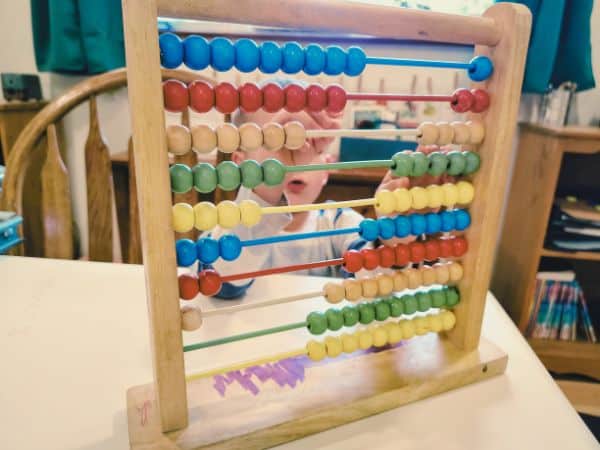
The abacus is a fantastic starting point for introducing patterns because it’s tactile and visual, making abstract ideas feel concrete. The beads slide back and forth in two directions, and the rows stack neatly on top of each other, creating distinct sets that are easy for little eyes to follow. I absolutely love the durability of a good wooden abacus—ours has survived countless drops, tugs, and even a few experiments from curious toddlers. If you don’t have one, they’re inexpensive and widely available online or at educational toy stores.
The core idea here is to create a simple set on the top row, and then have your child replicate that exact set on each subsequent row down to the bottom. This helps them understand patterns as repeating sets. It’s almost like a game of copycat. Start with all beads slid to the left for a clean slate. On the top rung, slide two beads all the way to the right, leaving the rest on the left. Show it to your child and say something encouraging like, “Look at this row—two beads on the right, and the rest on the left. Can you make the next row look just like this?”

Watch as they mimic it row by row. Once they’ve completed the entire abacus matching that simple pattern, try ramping up the difficulty gradually. For example, slide three beads to the right, position one in the center, and leave the others on the left. This adds variety without overwhelming them. Spread these increases over days or weeks, depending on the age of your child and how they’re responding. Some kids might master basic patterns in one session, while others need repetition to build confidence.
To make it even more interactive, let your child take the lead and challenge you. They create the top set, and you repeat it down the rows. Here’s a fun twist: Intentionally make a mistake on one row—maybe slide an extra bead or skip one. See if they notice and correct you. Start with obvious blunders, like completely reversing the pattern, and then move to subtler ones, like shifting just one bead. This not only tests their understanding but also turns it into a playful detective game. If they catch your errors consistently, it’s a strong sign they’re ready for the next stage.

Stage 2: Physical Practice with Counting Bears
Building on the abacus concept, we now transition to something more dynamic: physical objects that aren’t fixed in place. This stage shifts the focus from bead positions to attributes like color, introducing nuance and preparing them for real-world patterns. We’re using counting bears, which are colorful, sortable plastic bears in various hues and sizes. I prefer sets that include different sizes because they open up doors for advanced play later on—like sorting by size for patterns or even early graphing activities.
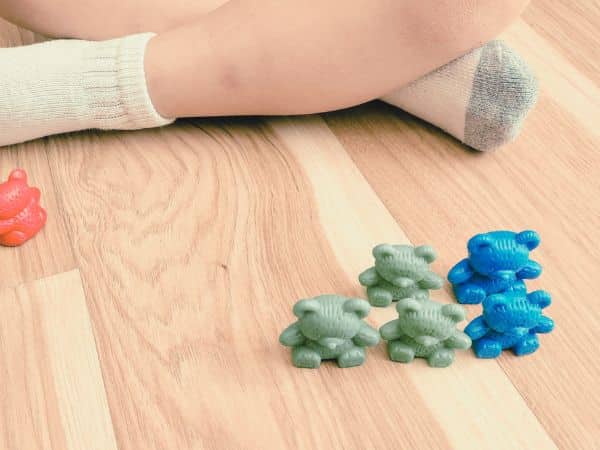
Start by laying out your first set in a straight row from left to right on a table or play mat. Keep it simple: blue, green, green. Then repeat the pattern partially, say blue, green—and pause. Ask your child, “What color comes next?” Regardless of their answer, place the correct one (green) and explain gently: “See? It goes blue, green, green, and then repeats: blue, green, green.” Now, to reinforce the set idea from the abacus, separate the long row into stacked rows, one set per row, just like the abacus rungs. This visual stacking helps them see the repetition clearly.

Many 3-year-olds find it easier when sets are separated like this, but the real challenge comes when everything is in one long row—they have to mentally group the sets. That’s why this stage often takes longer. If your child answers incorrectly, don’t push; just keep separating and stacking to make it clearer. Avoid increasing difficulty until they’re consistent. If frustration creeps in, reverse the process for a confidence boost: Stack a few complete sets, add the start of the next (such as, blue, green), and ask what comes next. They will usually get this. Then, unstack into one row to show the full pattern.

Stage 3: Visual Practice with the Drum Patterns Printable
Now that we’ve moved from fixed beads to free objects, it’s time to go visual and abstract a bit more with our free drum patterns printable. This takes the counting bears concept and flattens it onto paper, encouraging your child to mentally separate sets without physical manipulation. It’s a big step toward independent pattern recognition, and it’s themed around drums to tie into rhythmic music.
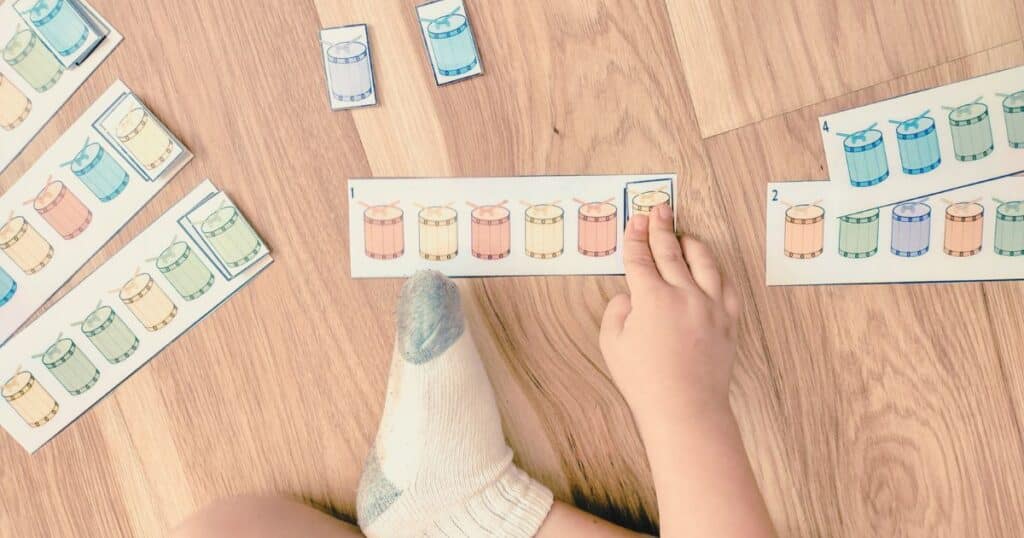
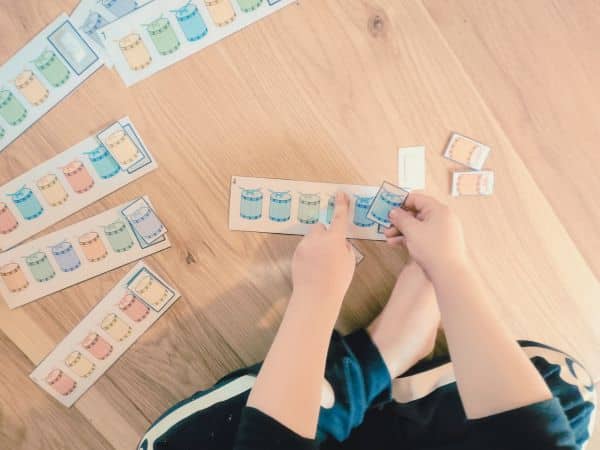
The printable features strips with partial patterns using drum icons in different colors or styles—think red drum, blue drum, yellow drum in sequences. Your child fills in the blanks with matching pieces. To make it reusable, I recommend laminating the sheets, cutting out the pieces, and adding Velcro dots for easy sticking. If you prefer low-prep, just print and cut for one-time use. Start simple: Give them just three pattern strips and a handful of answer pieces. As they get comfortable, add more strips and increase complexity, like longer sequences or patterns with more elements (e.g., red-blue-yellow-red-blue).
Introduce it by saying, “Remember how we lined up the bears? Now let’s do it with drums on paper!” If they’re struggling to visualize the sets, let them use actual counting bears alongside the printable—match the colors and physically stack rows off to the side. This bridges the gap until they’re ready to do it mentally. Encourage verbalizing: “What comes after red-blue? Red-blue again!”
There’s no rush here—patterns can be tricky at this age, and brains need time to mature. If your child enjoys it, add challenges like timing them (gently) or creating their own patterns on blank strips. If not, set it aside and revisit later.

Using the Free Drum Patterns Printable
The free drum patterns printable is a vibrant, engaging tool designed to help your preschooler master pattern recognition in a fun, music-themed way. This printable brings the concept of patterns to life with colorful drum icons that appeal to young learners. It’s the perfect bridge from the hands-on counting bears stage to more abstract, visual thinking, helping your child practice identifying and completing patterns independently.
What’s Included in the Printable
The printable consists of several pattern strips, each featuring a sequence of drum icons in different colors (e.g., red, blue, yellow). The patterns vary in complexity, starting with simple two-color repeats (like red-blue-red-blue) and progressing to three-color sequences (like red-blue-yellow). Each strip has a blank space at the end where your child selects the correct drum color to complete the pattern. The set also includes cut-out drum pieces that match the colors on the strips, making it interactive and hands-on.
Tips for Success
- Start Small: Begin with fewer strips to avoid overwhelming your child. Two or three is plenty for the first session.
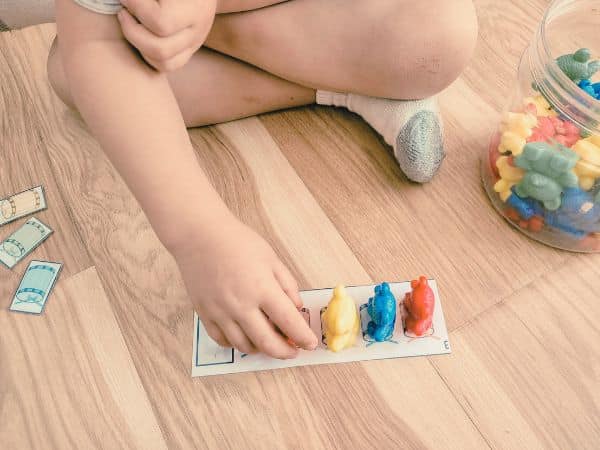
- Use Physical Aids: If they struggle, lay out counting bears in the same colors as the drums to recreate the pattern physically, then match it to the strip.
- Make It Musical: Since it’s drum-themed, add rhythm by clapping or tapping the pattern as you say the colors (such as, clap-clap-tap for red-red-blue). This ties into the theme and makes it multisensory.
- Celebrate Efforts: Praise their attempts, even if they pick the wrong color. Say, “Great try! Let’s look at the pattern together.” Keep the vibe positive to build confidence.
- Store Smart: Keep the pieces in a zip-lock bag or small container to avoid losing them.
Why It Works
The drum theme makes the activity feel like a game rather than a lesson, tapping into kids’ love for music and rhythm. By choosing the correct drum color to finish the pattern, they practice critical thinking and prediction skills. The visual format challenges them to mentally group sets, a key step toward advanced pattern recognition. Plus, the hands-on element of placing pieces keeps it engaging for wiggly preschoolers.
Books on Drums and Patterns
Reading together reinforces concepts through stories and illustrations, making learning even more memorable. I’ve curated a selection of books about drums (to tie into our printable theme) and books specifically about patterns. Use them as read-alouds before or after activities—point out patterns in the illustrations or mimic drum beats as you go.
Books About Patterns
- Pattern Fish by Trudy Harris: Underwater creatures create patterns with colors, shapes, and sounds. The repetitive text (“chomp, chomp, gulp”) forms auditory patterns, while illustrations show visual ones. It’s engaging and encourages kids to predict what comes next—perfect practice for our stages.
- A-B-A-B-A—a Book of Pattern Play by Brian P. Cleary: This math-focused book explains patterns through silly examples like animal parades and food sequences. Rhyming text makes it fun, and activities at the end suggest hands-on extensions, like using toys to mimic the book’s patterns.
- Beep Beep, Vroom Vroom! by Stuart J. Murphy: Cars in a toy box form color and shape patterns. The story builds suspense as patterns emerge, teaching prediction.
- Swirl by Swirl: Spirals in Nature by Joyce Sidman: While focused on spirals (a type of pattern), this poetic book shows patterns in nature like seashells and galaxies. Stunning illustrations spark wonder and lead to discussion on finding patterns in the world around us.

Books About Drums
- Hand, Hand, Fingers, Thumb by Al Perkins: This classic Dr. Seuss-style book is all about rhythm and drumming with your body. Monkeys drum on drums, thumbs, and each other in a catchy, repetitive rhyme. It’s perfect for introducing drum beats as patterns—read it aloud and clap along to the rhythm. My kids love the energy; it’s a great warm-up for our drum-themed printable.
- Drum Dream Girl: How One Girl’s Courage Changed Music by Margarita Engle: Inspired by a true story, this beautifully illustrated tale follows a girl in Cuba who dreams of playing drums despite cultural restrictions. The poetic text highlights rhythmic patterns in music and life.
- Pokko and the Drum by Matthew Forsythe: This charming picture book follows Pokko, a young frog who receives a drum from her parents and sets off into the forest, creating a rhythm that attracts an unexpected band of animal followers. The whimsical story, paired with vibrant, textured illustrations, celebrates creativity and music while subtly showcasing patterns through Pokko’s steady drumbeats and the growing parade. Perfect for preschoolers, it encourages clapping along to the beat, tying beautifully into the drum-themed pattern activities.
These books aren’t just entertaining; they’re tools to extend learning. Read one before starting a stage, or use them as rewards. They show patterns in context, making abstract ideas relatable.
Troubleshooting Common Challenges
Teaching patterns is rewarding, but it’s not always smooth sailing. Preschoolers are still developing their cognitive and fine motor skills, so you might hit a few bumps along the way. Don’t worry—these are normal and often easy to address with a few tweaks. Here’s a guide to common issues and practical solutions to keep the learning process fun and stress-free. If you’re concerned your child isn’t on pace for the average child their age, and you’ve attempted troubleshooting then you can check out the CDC’s milestones for your child based on their age up to 5.
Child Gets Distracted or Loses Interest
- Issue: Your preschooler might slide beads randomly on the abacus, scatter counting bears, or doodle on the printable instead of focusing.
- Solution: Shorten sessions to match their attention span—try 5-10 minutes. If they’re more interested in exploring than following instructions, let them play freely for a bit, then gently guide them back. For example, say, “Wow, you made a cool design! Want to try copying my row now?” If distraction persists, try a different time of day when they’re rested and fed.
Child Struggles to Identify or Complete Patterns
- Issue: They consistently pick the wrong color or bead position, or can’t predict what comes next.
- Solution: Simplify and backtrack. For the abacus, use fewer beads (for example, one bead right, rest left). With counting bears, stick to a two-color pattern (such as, red-blue) and keep sets separated into rows. For the printable, start with just one strip and model the answer aloud: “Red, blue, red—see the pattern?” Use physical objects alongside visuals if needed. Repetition is key; revisit earlier stages without judgment. My eldest needed weeks on the abacus and my middle kiddo required weeks with the counting bears, patience works wonders.
Child Gets Frustrated or Upset
- Issue: They shut down, cry, or refuse to try when they make mistakes.
- Solution: Pause and pivot to something positive. Praise effort: “You worked so hard trying that!” Switch to a simpler task they’ve mastered, like a basic abacus row, and celebrate success. Or take a break with a related activity, like reading a pattern book or clapping a rhythm together. Avoid correcting harshly; instead, model the correct answer cheerfully: “Oops, I think it’s green next—let’s try it!” If frustration is frequent, reduce session frequency to once or twice a week to keep it low-pressure.

Child Doesn’t Understand the Concept of Sets
- Issue: They can’t grasp that patterns are repeating groups, especially in long rows.
- Solution: Emphasize physical separation. On the abacus, point out each row as a team that matches the top. With bears, use paper strips or trays to group sets visibly. For the printable, trace sets with your finger and say, “This group is red-blue, and the next group is red-blue too!” If they’re still confused, what they may need is more time for their brain to develop.
General Tip: Adjust for Your Child’s Pace
Every child’s brain develops differently. If one stage isn’t clicking after a few tries, take a week or two off. Revisit patterns later—sometimes a break is all they need. Keep sessions playful, and watch for cues like smiles or eagerness to continue. If you’re unsure, try a mix of stages (such as, abacus one day, bears the next) to see what resonates.

Patience, Play, and Progress
Teaching patterns to your preschooler is a journey, not a race. Remember, not all children progress at the same rate—a brain must mature to grasp new concepts, especially math ones. Celebrate small wins, like correctly predicting a color or catching your mistake on the abacus. If things stall, revisit earlier stages or take a break; it’ll click when they’re ready. Instead enjoy finding patterns in the natural world.
Your little one is building skills that’ll last a lifetime, all while having fun. If you try these ideas, share your stories in the comments—we’d love to hear how it goes.
Recent Posts on the Homeschool Blog