Skip to content
TOUR NATURE
The 5 senses for kids in God’s creation.
— By Julie Hodos on September 22, 2024; Updated on October 29, 2025.

This post may contain affiliate links. Please refer to our disclosure policy.
When you step outside into the embrace of nature, do you ever pause to notice how your five senses come alive? Maybe it’s the sweet fragrance of blooming flowers wafting through the air, the cool dampness of morning dew under your bare feet, or the cheerful chirping of a bird perched on a nearby branch. For me, moments like these—like when the scent of our Camellia bushes fills the air or the crunch of leaves echoes underfoot—remind me how our five senses weave together to create lasting memories.
Table of Contents

Kids, with their boundless curiosity, experience a multitude of sensations in nature, even if they don’t yet have the words to describe them. A butterfly flutters by, a breeze tickles their skin, or a bird sings in the distance—each moment engages their senses, building a treasure trove of experiences they’ll carry into adulthood. Teaching children about their five senses through nature is a wonderful way to help them connect with the world around them. It’s not just about identifying what they see, hear, smell, touch, or taste—it’s about fostering an appreciation for the intricate ways these senses shape their understanding of their environment.
To guide the exploration of our 5 senses in nature, I draw inspiration from someone who understood the value of the five senses more deeply than most: Helen Keller. Despite losing her sight and hearing at a young age, she lived a remarkable life, cherishing the senses of touch, smell, and taste with extraordinary depth. Her writings remind us how precious our five senses are and how they allow us to experience the world’s beauty.
Why Explore the Five Senses in Nature?
You might be familiar with classic activities for teaching the five senses, like popping popcorn or roasting marshmallows over a campfire. These are fantastic ways to engage kids—after all, who doesn’t love the smell of fresh popcorn or the sticky sweetness of a perfectly toasted marshmallow? In our home, we’ve used popcorn during our preschooler’s Nn is for Nose week to spark excitement before a cozy movie night. But while these special activities are great, they often require planning and specific materials. Nature, on the other hand, is always there, ready to be explored. It’s an accessible, ever-present classroom that invites children to engage their senses every day.
By taking kids on a sensory tour of the outdoors, you’re not just teaching them about sight, sound, touch, smell, and taste—you’re helping them build a deeper connection with their environment. The next time they step outside, they’ll notice the world with fresh eyes, ears, and noses, appreciating the little details they might have overlooked before. This activity encourages mindfulness, curiosity, and gratitude, all while fostering a love for nature that can last a lifetime.
Read Next: Kids in Nature

Books About the Five Senses
To prepare your child for the sensory tour or reinforce what your child has learned during the sensory tour, reading books about the five senses is a wonderful way to spark further curiosity and connection. Here are some engaging, age-appropriate books that bring the concept of the five senses to life:
- A Picture Book of Helen Keller by David A. Adler: This beautifully illustrated biography introduces young readers to Helen Keller’s inspiring life, highlighting how she used her senses of touch, smell, and taste to navigate the world. It’s a great way to tie her story to your nature activity.
- Look, Listen, Taste, Touch, Smell by Pamela Nettleton: This book breaks down each sense in simple, clear language, making it perfect for preschoolers. It includes relatable examples and colorful illustrations to keep kids engaged.
- My Five Senses by Aliki: A classic choice, this book explores how the five senses help us understand the world. It’s interactive and encourages kids to think about their own sensory experiences.
- The Listening Walk by Paul Showers: This story follows a young girl and her father on a walk where they focus on the sounds around them. It’s a perfect companion to the hearing portion of your tour, encouraging kids to listen closely to their environment.
These books can be read before or after the 5 senses activity to spark discussion or reinforce learning. Consider visiting your local library to borrow them or adding them to your home collection for repeated reading.
The 5 Senses Activity in Nature
You could step outside and randomly choose a sense to focus on, but I’ve found that following a thoughtful sequence makes the experience more engaging and meaningful for kids. Below, I’ll walk you through how we explore the five senses in our home, including tips, conversation starters, and insights from Helen Keller to inspire your child’s curiosity. This activity is designed for younger kiddos but can be adapted for older kids by adding more detailed discussions or incorporating writing and drawing to document their observations.

Sight: Seeing the World with Fresh Eyes
“The only thing worse than being blind is having sight but no vision.” ~ Helen Keller
Sight is often considered the most dominant of our five senses, guiding us through the world with ease and keeping us safe from danger. I remember a school lesson about Helen Keller where we were asked to close our eyes and navigate the classroom. That evening, I tried it at home, a place I’d known my whole life, and was shocked at how disorienting it was. Even in familiar surroundings, I bumped into furniture and felt a newfound appreciation for my vision. Sight allows us to read, recognize faces, and marvel at the beauty of a sunset, yet it’s so easy to take it for granted.
We start our sensory tour with sight because it’s a natural entry point for exploring the outdoors. It’s also the sense kids will rely on to notice details throughout the rest of the activity. Begin by taking your child on a short walk in a park, backyard, or nearby nature trail. Give them a moment to settle into their surroundings, then gently ask, “What do you see around you?” Encourage them to name specific things: the green leaves swaying on trees, the rough brown bark of a trunk, the vibrant yellow of a dandelion, a red cardinal darting through the branches, or the endless blue of the sky.
To make it interactive, turn it into a game. Ask your child to point out five things they see, or challenge them to find something for each color of the rainbow. For younger kids, you might say, “Let’s find something green! Now something red!” Once they’ve made their observations, introduce the concept of sight in simple terms: “We have five senses, and one of them is sight. We use our eyes to see the world. What do we use to see? That’s right—our eyes!”
For older children, you can dive deeper. Talk about how sight is different from animal to animal, like how a hawk’s sharp vision helps it spot prey from high above. Share Helen Keller’s quote and ask, “What do you think it means to have vision, not just sight?” This can spark a conversation about imagination and perspective, encouraging kids to think beyond what’s in front of them.

Touch: Feeling the Textures of Nature
“The best and most beautiful things in the world cannot be seen or even touched – they must be felt with the heart.” ~ Helen Keller
Next, let’s explore the sense of touch. Nature is a treasure trove of textures, from the silky smoothness of a flower petal to the rugged surface of tree bark. Invite your child to pick up safe, natural objects to compare textures. Good choices include leaves (some are fuzzy, others glossy), smooth pebbles, rough bark, or delicate flower petals. Guide them to rub each item gently between their fingers and describe what they feel. Is it soft or hard? Smooth or rough? Cool or warm?
To make it fun, create a texture scavenger hunt. Ask your child to find something soft, something spiky, something bumpy, and something smooth. If it’s a sunny day, have them compare the warmth of a rock in the sunlight to one in the shade. You can also explore temperature by having them place one hand on a sunny patch of grass and the other on a shaded spot, asking, “Do they feel different? Why do you think that is?”
For a teachable moment, explain that touch is how our skin helps us learn about the world. “We use our skin to feel things. Our sense of touch tells us if something is hot, cold, soft, or rough.” Share how Helen Keller relied heavily on touch to see the world, using her hands to read Braille or feel the vibrations of music. This can lead to a discussion about how our senses work together to help us understand our surroundings.
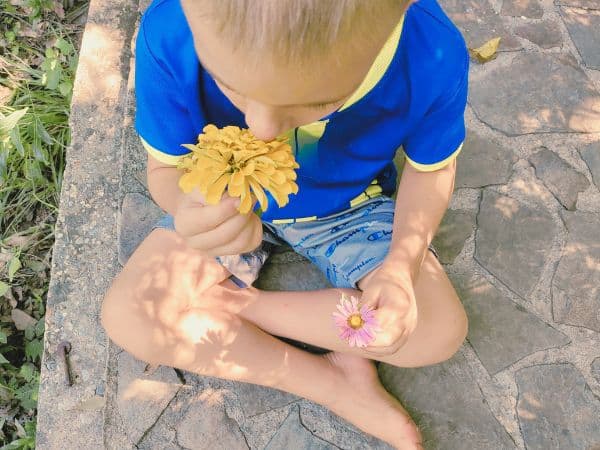
Smell: Capturing Memories Through Scents
“Smell is a potent wizard that transports you across thousands of miles and all the years you have lived.” ~ Helen Keller
The sense of smell is a powerful time machine, capable of whisking us back to forgotten moments with a single whiff. For me, the herbal scent of certain shops in Shipshewana, Indiana, instantly recalls joyful days spent antiquing with my family. Even years later, a similar scent in a boutique or market can flood my mind with memories of laughter and connection. Our olfactory system does more than warn us about spoiled food—it anchors us to our past in a deeply emotional way.
On your nature tour, guide your child to explore the scents around them. Flowers are an obvious starting point, with their sweet, buttery, or floral aromas. Encourage your child to sniff a variety of blooms, comparing their scents. But don’t stop there—tear a leaf in half to release its earthy fragrance, or rub a pine needle to unlock its crisp, resinous smell. If a plant has no noticeable scent, acknowledge it: “Not everything in nature has a strong smell, and that’s okay. Let’s find something else to sniff!”
To engage your child further, ask, “Does this smell remind you of anything?” For example, the scent of pine might evoke memories of a Christmas tree, or a flower’s fragrance might remind them of a garden they visited. Explain, “We use our nose to smell things, and our sense of smell can bring back special memories.” Share Helen Keller’s insight about smell being a “potent wizard” and ask your child to imagine where a scent might take them if they closed their eyes.
Read Next: Scent Game

Taste: Understanding Safe Choices in Nature
“Smell the perfume of flowers, taste with relish each morsel, as if tomorrow you could never smell and taste again.” ~ Helen Keller
When it comes to taste, nature requires caution. This is a great opportunity to teach kids about safety while still engaging their sense of taste in a meaningful way. Explain that many plants in the wild are not safe to eat and could make us sick. Instead of tasting things outside, shift the conversation to foods they already know. Ask, “What plants do we eat at home? Do you like the taste of broccoli or carrots? What’s your favorite fruit?” This opens a discussion about why some foods taste better than others and how our tongue helps us enjoy flavors.
To make it interactive, you can bring along a safe, nature-inspired snack, like apple slices or baby carrots, and have your child describe the taste. Is it sweet, crunchy, or juicy? Explain, “We use our tongue to taste things, and our sense of taste helps us enjoy food and stay safe by telling us what’s good to eat.” For older kids, you can talk about how animals use taste to choose safe foods, like how a deer knows which plants are edible.

Hearing: Listening to Nature’s Symphony
“Blindness separates people from things; deafness separates people from people.” ~ Helen Keller
Finally, we arrive at the sense of hearing. Before introducing it, review the senses you’ve already covered. Point to each body part as you say, “We use our eyes to see, our skin to touch, our nose to smell, and our tongue to taste. There’s one more sense—what do you think it is?” Then, invite your child to close their eyes and listen quietly for a moment. Ask, “What do you hear?” They might notice birds chirping, leaves rustling in the wind, or the hum of distant traffic. If they’re struggling to identify sounds, point out specific ones, like a squirrel scampering or a dog barking in the distance.
To deepen the five senses experience, turn it into a listening game. Ask your child to count how many different sounds they hear in one minute, or challenge them to mimic a sound they notice, like a bird’s call. Explain, “We use our ears to hear, and our sense of hearing helps us notice the world’s sounds, like music, voices, or animals.” Share Helen Keller’s perspective on how hearing connects us to others, and encourage your child to think about how sounds in nature make them feel—calm, excited, or curious.
Read Next: 5 Senses Activities for Kids

Wrapping Up the Sensory Tour
By exploring the five senses in nature, your child will develop a deeper appreciation for their surroundings and the incredible tools their body provides. To wrap up the five senses activity, revisit the senses one more time, pointing to each body part and naming its role. Then, grab a cozy spot and read one of the recommended books to reinforce what they’ve learned.
As Helen Keller wrote in her essay Three Days to See:
“I who am blind can give one hint to those who see: Use your eyes as if tomorrow you would be stricken blind. And the same method can be applied to the other senses. Hear the music of voices, the song of a bird, the mighty strains of an orchestra, as if you would be stricken deaf tomorrow. Touch each object as if tomorrow your tactile sense would fail.
“Smell the perfume of flowers, taste with relish each morsel, as if tomorrow you could never smell and taste again. make the most of every sense; glory in the beauty which the world in all the facets of pleasure reveals to you through the several means of contact which Nature provides. But of all the senses, I am sure that sight is the most delightful.”
Her words remind us to cherish every sensory experience, and by guiding your child through this five senses activity, you’re helping them do just that. To learn more about Helen Keller you can visit this biography.

Tips for Success
- Keep It Simple: For preschoolers, focus on one sense at a time and use simple language. For older kids, add more details or encourage them to journal their observations.
- Stay Safe: Always supervise children during outdoor activities and ensure they don’t touch or taste anything harmful.
- Make It Fun: Turn the tour into a game or story to keep kids engaged. For example, pretend you’re explorers on a sensory adventure.
- Adapt to Your Environment: Whether you’re in a backyard, park, or forest, use what’s available. Even a small patch of grass can spark curiosity.
- Follow Their Lead: Let your child’s interests guide the tour. If they’re fascinated by a particular flower or sound, linger there and explore it further.
Exploring the Senses God Gave Us
Exploring the five senses in nature is more than an educational activity—it’s a chance to slow down, connect with your child, and marvel at the world together. By guiding them to notice the vibrant colors, unique textures, evocative scents, and lively sounds around them, you’re helping them build a lifelong appreciation for their senses and the natural world. As Helen Keller’s wisdom reminds us, our senses are gifts to be cherished, opening the door to a world of wonder and discovery.
So, grab your child’s hand, step outside, and embark on this sensory adventure. You’ll be amazed at how much joy and learning a simple walk in nature can bring. Share in the comments below what your child has noticed in nature from doing this five senses activity.
5 Senses Tour in Nature
AT A GLANCE ACTIVITY INSTRUCTIONS
Materials
- Nature
Instructions
- Plan a day to go on a walk.
- Discuss the sight sense first by discussing what your child sees around them.
- Choose a plant or two whether it be a bush, tree, flower, etc. and pick a leaf from both or a leaf and a flower.
- Compare the feel of the different leaves; some are fuzzy while others are smooth. Or how some flower’s petals are thin and fragile while others are stiff. Or the barks on trees. Or the cool dirt and warm grass. There are lots of different things to explore with our sense of touch in nature.
- Next up is the sense of smell. Flowers are easy ones but try a leaf too by breaking/tearing it. If you don’t smell anything, state that too. There’s nothing wrong with a plant not smelling like something.
- Now is the time to discuss why we don’t use our sense of taste when in nature because many plants are not edible and could hurt us.
- Lastly, continue on your walk and ask your child what senses they’ve used. Review with prompting as needed. Once you get through the four you’ve completed, ask them what the 5th sense is that they haven’t used yet.
- The sense of hearing. Pause on your walk and have them close their eyes and just listen to the world around them, what do they hear? If they’re struggling to identify noises, prompt them with one that you hear. Wind rustling through the leaves, birds, or even traffic or a dog barking.
Recent Posts on the Homeschool Blog