

OBSERVE & CONNECT
How to teach kids in nature to be independent learners.
— By Julie Hodos on May 16, 2025; Updated on January 14, 2026.

This post may contain affiliate links. Please refer to our disclosure policy.
Maybe you’re here because you want to take your daily nature walks with your child to the next level. Or you’ve stumbled upon this post because you’re eager to help your little one enjoy being outside more—and hey, maybe rediscover that joy for yourself too. As a mom of three energetic boys, I get it: getting kids excited about the great outdoors isn’t always as simple as opening the back door. But with a straightforward 4-step process, you can ignite a genuine interest and love for the natural world in your child. We’ll inspire questions, explore answers together, and connect through reflection and creative expression.
Table of Contents

This guide is perfect for busy families who want practical, actionable tips to make nature time more meaningful. We’ll dive into why independent learning matters, how to teach it effectively, and break down my go-to method: S.I.S.E. (Senses, Investigation, Silence, and Expression). Whether you’re dealing with a daydreamer who’d rather sword-fight with sticks or a curious questioner glued to their phone, this approach balances play, curiosity, and focus. Plus, it’s adaptable for any age, location, or group size. Let’s make those outdoor adventures unforgettable!
Why Do Kids in Nature Need to Be Independent Learners?
In today’s fast-paced world, being an independent learner isn’t as common as it used to be—and that’s a real shame. Think about it: our kids are often spoon-fed information at school, with schedules dictating what to learn and when. On top of that, there’s an overwhelming flood of content from screens, social media, and apps, leaving little room for them to chase their own curiosities, ask those “why” questions that spark deeper thinking, or get creative on their own terms. As parents, we see this play out every day, right? They might know all the facts about their favorite video game characters, but when it comes to exploring the world around them, motivation can fizzle out.
Fortunately, nature is one of the easiest and most captivating topics to hook kids on. It’s no coincidence that elementary science curriculums lean heavily into the natural world—think plants, animals, weather patterns, and ecosystems. There are endless mysteries waiting to be uncovered: Why do leaves change color in the fall? How do birds know where to migrate? What’s that weird bug doing on the flower? These aren’t just random facts; they tap into our innate human desire to understand and connect with our environment. Nature isn’t static—it’s alive, dynamic, and full of surprises that can light up a child’s imagination.
By simply getting kids outside, we’re setting the stage for incredible learning opportunities. Fresh air, open spaces, and real-world wonders beat any textbook. But here’s the catch: just plopping them in a park or backyard without any guidance can lead to some common pitfalls. Without a gentle nudge, kids often swing to one of two extremes, and I’ve seen both with my own boys.

The Eternal Daydreamer
First, there’s the “eternal daydreamer.” This is the child who gets scattered, unsure where to direct their attention. They might spot a stick and instantly transform it into a magic wand or a pirate’s sword, diving headfirst into imaginative play. Or they could just sit and stare, observing passively without digging deeper. Don’t get me wrong—play is essential! I’ve watched my sons stage epic battles in the woods, and it’s pure joy. It builds creativity, problem-solving, and even social skills if siblings or friends are involved. But if that’s all that happens, they miss out on the educational goldmine nature offers. We want to channel that energy into focused exploration, blending fun with learning.
Must-Have-All-The-Answers-Now
On the flip side, there’s the “must-have-all-the-answers-now” kid. These little investigators are bursting with questions, which is fantastic—it shows curiosity! But without balance, they might spend the entire outing glued to a device, frantically searching for facts.
Picture this: You’re on a peaceful nature walk, pointing out a vibrant green caterpillar crawling on a leaf. Instead of marveling at its fuzzy body or watching it munch away, your child whips out their phone to Google “What butterfly does this turn into?” Before you know it, they’re down a rabbit hole of Wikipedia pages, missing the magic of the moment. This hyper-focus on answers can rob them of the sensory experience, turning nature time into a rushed research session rather than a mindful adventure.
So, why push for independent learning specifically in nature? Because it empowers kids to own their discoveries. When they learn to observe, question, research, and reflect on their own, they build confidence, resilience, and a lifelong love for learning. Nature provides the perfect, low-stakes playground for this. No grades, no deadlines—just pure, hands-on exploration. Plus, studies show that time in nature reduces stress, boosts mood, and even improves attention spans. By teaching independence here, we’re not just educating; we’re nurturing well-rounded, curious humans who can navigate an information-overloaded world.

Recommended Books for Parents
Inspire more outdoor time for kids with these thoughtful books. They offer research, real-life stories, and practical ideas to help parents like us reclaim childhood through nature. Each one reminds us why getting outside matters and how to make it happen—even on busy days.
- Last Child in the Woods: Saving Our Children from Nature-Deficit Disorder by Richard Louv This groundbreaking book coined the term “nature-deficit disorder” and explores how a lack of outdoor time affects children’s physical, emotional, and mental health, while offering hopeful solutions and inspiration to reconnect families with the natural world.
- 1000 Hours Outside: Prioritize Nature, Reclaim Childhood and Experience a Fuller Life by Ginny Yurich From the founder of the global 1000 Hours Outside movement, this book shares the story behind the challenge to balance screen time with green time, providing encouragement and simple steps for families to spend more meaningful hours outdoors together.
- Balanced and Barefoot: How Unrestricted Outdoor Play Makes for Strong, Confident, and Capable Children by Angela J. Hanscom Written by a pediatric occupational therapist, this practical guide explains how free play in nature builds essential physical, social, emotional, and cognitive skills, with tips to help kids thrive through more unstructured outdoor time.
- How to Raise a Wild Child: The Art and Science of Falling in Love with Nature by Scott D. Sampson This engaging book combines science and storytelling to show why kids need nature from an early age, offering mentoring strategies and activities for parents, caregivers, and educators to foster a lifelong bond with the outdoors.
- Outdoor Kids in an Inside World: Getting Your Family Out of the House and Radically Engaged with Nature by Steven Rinella A fun, hands-on call to action from the MeatEater host, this book provides practical advice for activities like camping, gardening, fishing, and hunting to get kids off screens and deeply connected to nature in exciting, everyday ways.
These reads are perfect companions to the S.I.S.E. process—they’ll fuel your motivation and give you fresh ideas to keep those nature adventures going strong. Which one are you adding to your reading list first? I’d love to hear in the comments! Happy reading and even happier outdoor time.

How to Teach Independent Learning to Kids in Nature
Teaching independent learning doesn’t have to be complicated or feel like a classroom lesson. It’s about guiding without controlling, sparking interest without dictating. We want our kids to use their imaginations, but direct it toward the wonders around them. We encourage questions, but also teach them to savor the observation phase before jumping to answers. The goal? Help them find a sweet spot between playful exploration and purposeful inquiry, all while keeping their natural spirit alive.
Start small and build from there. If your child is new to this, begin in familiar spots like your backyard or a neighborhood park. This reduces overwhelm and lets them ease into the process. Model the behavior yourself—show enthusiasm for what you notice, ask open-ended questions like “What do you think that bird is doing?” and resist the urge to provide all the answers immediately. Praise their efforts, no matter how small: “I love how you noticed that flower’s petals—great observation!”
One key strategy is to incorporate tools that make learning accessible and fun. Field guides, magnifying glasses, insect nets, or simple journals can turn a casual walk into an adventure. Discuss how to use technology wisely—phones are great for quick lookups, but not at the expense of being present. Teach them search skills: “Let’s try phrasing it as ‘green caterpillar common in our area’ to get better results.” This builds efficiency, so they can satisfy curiosity without derailing the experience.
Repetition is your friend. The more you practice, the more natural it becomes. Aim for consistency, like weekly outings, and gradually step back as they take the lead. Celebrate wins, like when they identify a plant on their own or share a new fact they discovered. Remember, every child is different—tailor your approach to their personality. For daydreamers, set gentle timers for focused activities; for eager researchers, encourage “phone-free zones” during certain steps.
I’ve developed a simple, effective 4-step plan called S.I.S.E. to make this process foolproof. It stands for Senses, Investigation, Silence, and Expression, and it’s designed to work on nature walks, in backyards, or even during family hikes. You can do it in one session or spread it out, and it’s flexible for groups or just your family. The beauty? By repeating it seasonally in the same spot, kids start noticing changes—like how a pond freezes in winter or blooms in spring—which deepens their connection. After a few rounds, they’ll guide themselves through it, becoming true independent learners. Excited? Let’s break it down.

S.I.S.E.: The Four-Step Process for Building Independent Learners
S.I.S.E. is my tried-and-true method, honed from years of outdoor adventures with my boys. It’s practical, time-bound, and engaging, ensuring kids get a well-rounded experience without feeling structured or boring. Each step builds on the last, creating a flow that sparks curiosity, satisfies it, allows reflection, and encourages creativity. Total time? About 35-75 minutes, depending on your child’s age and interest. Pro tip: Pack snacks, water, and comfy clothes to keep everyone happy. Now, let’s dive into each step with tips, examples, and how-tos.
Step 1: Senses – Awakening Curiosity Through the Five Senses
Time: 10-15 minutes (adjust for detail and age—shorter for toddlers, longer for older kids).
Kick things off by engaging the five senses: sight, sound, smell, taste, and touch. This step is all about tuning in to the environment and noticing details that might otherwise go overlooked. It’s the foundation for curiosity—once kids start observing closely, questions naturally bubble up.
How to do it: Sit or walk slowly in your chosen spot. Ask guiding questions like, “What do you see that’s colorful or moving?” For sound: “Close your eyes—what noises do you hear? Birds chirping? Leaves rustling?” Smell: “Sniff the air or a flower—what does it remind you of?” Touch: “Feel the bark of a tree or grass under your feet—is it rough, soft, wet?” Taste: Proceed with caution! Stick to safe, known items like edible berries if you’re knowledgeable, but generally skip this or use it metaphorically (for example, “Imagine tasting fresh rain”).
Why it works: This multisensory approach helps scattered daydreamers focus and prevents answer-hunters from skipping ahead. For example, on a recent walk, my 5-year-old noticed the earthy smell after rain, leading to questions about worms.
I have a whole post on Exploring the 5 Senses in Nature, including insights from Helen Keller on appreciating the five senses uniquely. Check it out for more inspiration. Remember: No tasting wild plants unless you’re 100% sure it’s safe—safety first!
Step 2: Investigation – Seeking Answers with Purpose
Time: 10-20 minutes (varies by location, age, and familiarity—repeat sessions go faster).
Now that curiosity is piqued, it’s time to dig in. This step satisfies the eager researchers by teaching efficient ways to find answers, so they can quickly return to enjoying the moment.
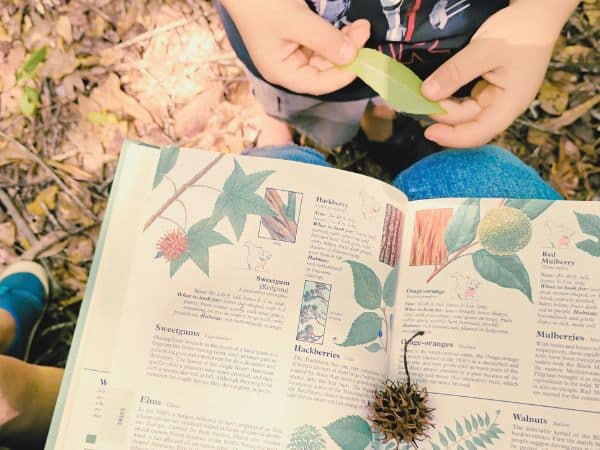
How to do it: Based on observations from the senses step, list 2-3 questions to explore. Use a mix of tools: A regional field guide (I recommend ones with pictures for kids) for offline lookups, or a phone for quick searches. Teach smart researching: “Let’s word our question clearly, like ‘What eats acorns in forests?’” Discuss sources—pick reliable ones like educational sites over random forums. If in a group, take turns sharing findings.
Examples: Spot a bird? Use a hardcopy, field guide to identify it as a robin and learn about its diet. See animal tracks? Search “common forest animal tracks” to guess if it’s a deer or rabbit. With my boys, we once investigated why mushrooms grow in circles, discovering “fairy rings” and the science behind them—it was a hit!
Tips: Balance tech and analog—start with the book to build non-digital skills. If your child gets stuck, offer hints without giving away answers. This builds problem-solving and patience.
I love using a field guide because it truly teaches you the different things to analyze a plant on (such as a leaf is analyzed by structure, shape, margin, venation, and arrangement on stem). This leads to better informed and quicker searches in the future.

Step 3: Silence – Reflecting and Absorbing the Moment
Time: 5-10 minutes (shorter for wiggly young ones; tolerance can be built up over time).
This is my absolute favorite— a quiet pause to let everything sink in. No talking, just being present with nature and personal thoughts.
How to do it: Find a comfy spot to sit or lie down. Set a timer if needed. Everyone observes silently: Watch clouds drift, listen to wind, or ponder earlier discoveries. It’s okay if minds wander—that’s part of it! The rule: No voicing thoughts to avoid interrupting others.
Why it works: Daydreamers get their imaginative space, while questioners learn to appreciate without constant analysis. Ultimately, it fosters mindfulness and may inspire new questions, inquiries, and deeper insights. In our family, my 7-year-old realized how seasons affect animal behavior.
Pro tip: If silence is tough, start with 2-3 minutes and use it as a “recharge” break. Appreciate the beauty around you—it’s a chance to connect spiritually or simply relax.

Step 4: Expression – Bringing It All to Life Creatively
Time: 10-30 minutes (flexible based on age and energy—keep it fun, not forced).
Wrap up by externalizing what’s been learned and felt. This step lets kids process creatively, turning observations into something tangible.
How to do it: Options abound! Draw or sketch findings (nature journaling is perfect—grab watercolor palettes for color pops). Write a short story or poem about the adventure. Act it out through play, like pretending to be the caterpillar from earlier. For groups, share verbally: “What surprised you today?”
Examples: My daydreamer son might build a fort from sticks inspired by animal homes, while the artist sketches birds. We use simple supplies: Notebooks and colored pencils.
Tips: Encourage variety—rotate activities to keep it fresh. Nature journaling combines art and notes; I always carry compact watercolor sets for on-the-go painting or colored pencils. Both are easy to tote around. Overall this teaches learning and boosts self-expression.
The Benefits of Nature-Based Learning for Child Development
Diving deeper into why S.I.S.E. and nature time are so powerful, let’s talk about the broader benefits for your child’s growth. Nature-based learning isn’t just a fun add-on; it’s a powerhouse for development across multiple areas. Physically, being outdoors encourages movement—running, climbing, balancing on logs—which builds gross motor skills, strength, and coordination. My boys come home rosy-cheeked and exhausted in the best way, sleeping like logs after a day of exploration.
Mentally, nature sharpens focus and problem-solving. Research from organizations like the Children & Nature Network shows that kids who spend time outside have better attention spans and lower ADHD symptoms. The unstructured play in S.I.S.E. lets them experiment, fail, and try again, fostering resilience. Emotionally, it’s a stress-buster. The calm of a forest or park reduces anxiety, boosts self-esteem, and teaches empathy—think caring for a found insect or understanding ecosystems.
Socially, if you do S.I.S.E. in groups, it promotes teamwork and communication. Kids share discoveries during expression, learning to listen and collaborate. Cognitively, it enhances creativity and critical thinking. Observing cycles like seed growth or animal habits introduces science concepts organically, making school lessons more relatable. Plus, it instills environmental stewardship—kids who love nature grow up wanting to protect it.
In our screen-dominated era, nature reconnects kids to the real world, countering “nature deficit disorder.” It’s holistic: body, mind, and spirit. As a parent, seeing my kids light up over a simple leaf discovery reminds me how these experiences shape kind, curious individuals. Incorporate S.I.S.E. regularly, and you’ll notice improvements in mood, curiosity, and even family bonds.

Overcoming Common Challenges in Outdoor Exploration
Let’s be real—nature outings aren’t always picture-perfect. Weather, bugs, or reluctant kids can throw a wrench in plans. But with practical strategies, you can overcome these hurdles and keep the fun flowing.
First, bad weather: Rain or cold doesn’t have to cancel everything. Dress in layers, grab rain boots, and turn it into an adventure—puddle jumping during senses or investigating rain’s smell. For extreme heat or cold, shorten sessions or choose shaded spots. Always check forecasts and have indoor backups, like window-watching birds.
Bugs and wildlife fears? Educate gently: Use bug spray, long sleeves, and teach “observe, don’t disturb.” Turn it educational—investigate why mosquitoes buzz. For nature-averse kids, start tiny: A potted plant on the porch for senses practice. Build tolerance gradually; praise bravery.
Time constraints for busy families? S.I.S.E. is flexible—do one step per day or mini-versions during lunch breaks. Involve siblings or friends to share supervision. Motivation dips? Make it game-like: “Sense scavenger hunts” or rewards like hot cocoa post a winter outing.
Accessibility issues? Choose wheelchair-friendly parks or urban green spaces. For sensory sensitivities, adapt steps—like quieter locations for silence. Safety is key: Teach poison ivy identification, stay on paths, and supervise water areas.
With patience, these challenges become teachable moments. Remember, consistency wins—small, positive experiences build a lifelong love.
Activities to Build on S.I.S.E.
Once your family masters S.I.S.E., amp it up with extensions for variety and deeper engagement. These keep things fresh, extending learning without overcomplicating.
- Citizen science projects: During investigation, use apps like iNaturalist to log findings and contribute to real research. Kids love seeing their photos help scientists and it boosts the overall experience with tangible purpose.
- Nature crafts: Post-expression, collect safe items (leaves, rocks) for home projects like leaf rubbings or rock paintings. Overall, this ties into creativity and reinforces previous observations.
- Seasonal themes: Adapt S.I.S.E. for holidays—fall leaf hunts or winter snow tracking. In spring, focus on buds and in summer on insects.
- Family challenges: Set goals like “identify 5 new plants this month.” Track in a shared journal for reflection.
- Tech integrations: Use free apps for augmented reality, like Seek for instant identifications during investigation, but limit the use of technology to enhance and not replace hands-on investigation.
These add-ons evolve with your child and S.I.S.E will eventually become second nature. When this happens you’ve instilled in your child an independent learner in nature.

Special Considerations for Different Kids and Situations
Every child is unique, so tweak S.I.S.E. to fit. If your kiddo is nature-averse (maybe bugs freak them out or they prefer indoors), start small in the backyard. Break the steps into separate days over a week: Senses on Monday, Investigation on Tuesday, etc. This builds comfort gradually. Once they’re hooked, venture to a park or trail, combining all steps in one go.
For frequent nature-goers, don’t overdo it—once a month keeps it special without burnout. With my boys (ages 7, 5, and 3), we do full S.I.S.E. sessions seasonally, noticing how our favorite spot transforms: Bare trees in winter, wildflowers in spring. It’s magical watching them spot differences independently.
Age matters too. For toddlers, shorten times and focus on fun—lots of touching and simple questions. Older kids can handle deeper investigations, like using apps for bird calls. Groups? Assign roles, like one kid leading senses. Poor weather? Adapt indoors with nature videos or potted plants, but aim for real outdoors when possible.
Safety first: Supervise closely, teach “look but don’t touch” for unknowns, and check for allergies.
Pack essentials: Sunscreen, bug spray, first-aid kit. If special needs are involved, like sensory sensitivities, modify senses (such as, skip strong smells).
For everyone: Commit to at least four sessions a year, one per season, in the same location. This highlights cycles and changes, deepening appreciation and understanding of this amazing world God created.

S.I.S.E. Is for Everyone
Everything we dream for our kids in nature—curiosity, knowledge, reflection, and creativity—is bundled into S.I.S.E. It starts with senses to spark questions, moves to investigation for answers (using guides and tech wisely), allows silence for processing, and ends with expression through art or play. It’s adaptable for any age, from toddlers to teens, in backyards or wilderness, alone or in groups. Most importantly, it fosters a profound connection to the natural world, teaching independence that spills into all areas of life.
What’s your favorite step? Is it the peaceful silence, like me, or the creative expression? Drop a comment below—I’d love to hear from other parents and swap stories. Maybe you’ve got tweaks or success tales to share.
Overall, I adore how S.I.S.E. grows with your family, turning routine outings into enriching experiences. It’s helped my boys become more observant, patient, and excited about learning. No more aimless wanders or repeatedly asking to look up a new discovery on the phone—just balanced, joyful exploration. What are you waiting for? Nature’s calling—grab your kids, head outside, and give S.I.S.E. a try today. You’ll be amazed at the wonders you uncover together!
Recent Posts on the Blog




Always looking for fun ways to engage my grandkids in fun opportunities where learning is fun! This is great!