FLOWER PRESSING
Create a dried flower bookmark.
— By Julie Hodos on April 6, 2025; Updated on January 24, 2026.
This post may contain affiliate links. Please refer to our disclosure policy.
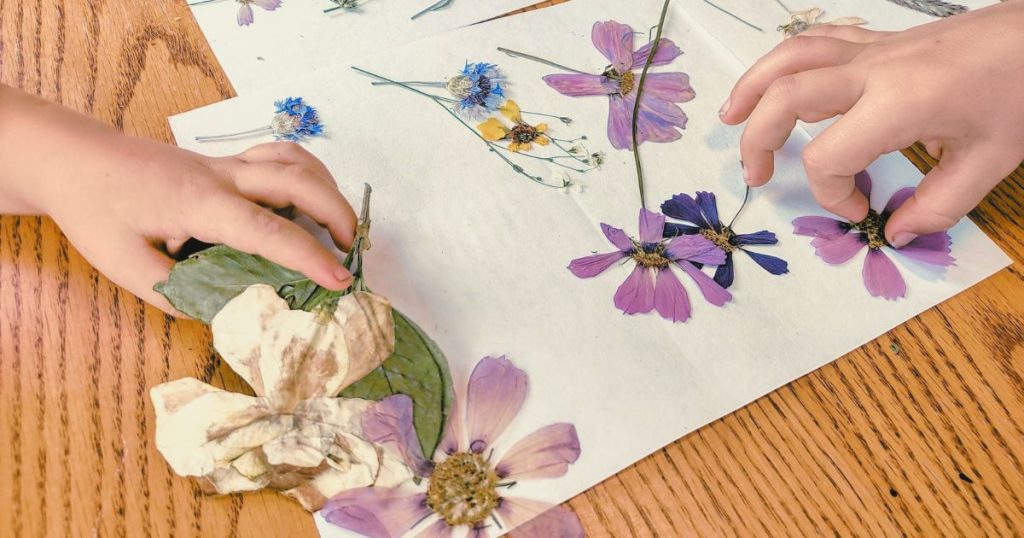
We absolutely love flower pressing in our home. There’s something so satisfying about heading out on a little adventure with the kids, snagging a handful of colorful blooms, and then—three or four weeks later—opening the press to discover perfectly flat, jewel-toned flowers that look like they belong in a fairy-tale book.
Once they’re dry, the possibilities are endless: we frame them for sweet wall art, glue them onto homemade greeting cards, turn them into Christmas ornaments, embed them in candles, swirl them into bars of soap, or—my family’s hands-down favorite—transform them into the most beautiful bookmarks you’ve ever slipped between the pages of a novel.
Table of Contents

Making dried flower bookmarks is easy, completely safe for even the youngest helpers, ridiculously inexpensive, and (let’s be honest) we always need more bookmarks because books are basically another food group around here. The kids get to arrange the flowers exactly the way they imagine, pick out ribbons in their favorite colors, write their names in proud wobbly letters, and walk away with something genuinely useful and pretty. It’s the kind of project that feels like pure magic from start to finish.
Here’s everything you need to turn this simple activity into a rich, memorable learning experience—complete with book recommendations, poetry, gathering tips, troubleshooting, seasonal ideas, and plenty of encouragement along the way.
Why Press Flowers with Kids?
Pressing flowers checks every single box on a parent’s secret wish list. It naturally slows everyone down in the best possible way—waiting three weeks for the flowers to dry is built-in patience practice. It sharpens observation skills as children notice petal shapes, vein patterns in leaves, and the way colors shift as moisture leaves the plant. It strengthens little fingers while arranging delicate blooms, and it introduces basic botany without ever feeling like a textbook lesson. Best of all, you end up with bookmarks to keep and use for years. In a world of instant gratification and flashing screens, the slow reveal of perfectly pressed flowers feels almost revolutionary—and kids adore that moment of “ta-da!”
Turn One Craft into an Entire Homeschool Unit
What starts as a simple afternoon project can easily stretch into an entire unit of joyful learning.
- During morning basket, read flower-themed picture books together.
- Practice sketching flowers in a nature journal.
- Download the free Flower Anatomy printable and label real petals, sepals, stamens, and pistils.
- Plant a wildflower garden in your backyard so your child can watch the entire life cycle unfold.
- Dissect parts of a flower under a magnifying glass.
- Press flowers and make crafts, beyond bookmarks if you want! Gift these to others if you don’t need more crafts lying around.
And just like that you’ve covered science, art, handwriting, reading, and even character (because sharing beauty with others feels good). It’s relaxed, play-based learning at its finest.
Read Next: Morning Basket 101

Our Family’s Favorite Children’s Books About Flowers
These are the books we pull off the shelf again and again whenever flowers are the theme of the week:
- Flowers by Gail Gibbons – clear, colorful diagrams and just the right amount of information for ages 4–9.
- Planting a Rainbow by Lois Ehlert – a celebration of color and gardening that makes everyone want to dig in the dirt.
- The Flower Alphabet Book by Jerry Pallotta – alphabet practice plus fascinating facts; perfect for early readers.
- The Reason for a Flower by Ruth Heller – delightful rhyming text that explains pollination in a way even preschoolers understand.
- A Seed Is Sleepy by Dianna Hutts Aston and Sylvia Long – poetic language paired with breathtaking illustrations.
- From Seed to Plant by Gail Gibbons – another winner from Gail that connects flowers to the bigger world of plants.
- Miss Rumphius by Barbara Cooney – the gentle story of the Lupine Lady who makes the world more beautiful (and inspires children to do the same).
We usually keep a basket of these books on the porch or coffee table while the flower press is doing its quiet work.

Flower Poems That Beg to Be Read Aloud
Poetry and pressed flowers go together like sunshine and gardens. Curl up on the couch or under a tree and try these:
- The Flowers from A Child’s Garden of Verses by Robert Louis Stevenson – short, sweet, and written from a child’s point of view.
- A child-friendly version of Wordsworth’s “Daffodils” – pure joy on a page.
- The flower section in Favorite Poems Old and New selected by Helen Ferris – this thick anthology lives on our poetry shelf and gets pulled out constantly.
- Any of Emily Dickinson’s tiny flower poems – perfect for copywork or memorization.
Read them out loud (poetry is meant to be heard), then head outside to hunt for the exact flowers mentioned. Press one and tape it right next to the poem in your nature journal. Connection made.
Read Next: 10+ Classic Poems for Kids

Where to Ethically Gather Flowers
The very best flowers come with a story attached, so we always try these options first:
- Grow your own. Even a few pots on an apartment balcony count. Wildflower mixes, zinnias, cosmos, marigolds, pansies, and violets press beautifully and grow quickly enough to keep kids interested.
- Ask a neighbor. Bring them a finished bookmark later—they’ll be thrilled.
- Visit a U-Pick flower farm (search “you-pick flowers near me”). Many have buckets for $10–$20 and let kids cut their own stems.
- Nature walks and public parks—pick only where signs allow and take just a few stems.
- Grocery-store bouquets are a great alternative if all else fails.
Whatever you choose, turn the gathering into part of the lesson: notice pollinators, smell the scents, compare leaf shapes.
How to Press Flowers Perfectly
Pressing flowers is relatively easy! You can do it between the pages of an old encyclopedia book using parchment paper and then stacking heavy books on top. Or grab the flower press our family loves -it’s convenient for keeping everything together when in use and not in use. Best of all, many flowers and leaves fit on each layer without any hassle and no precarious stacking, which can come from using books.
- Pick on a dry day after the morning dew has evaporated.
- Choose thin-petaled flowers—pansies, violets, daisies, cosmos, Queen Anne’s lace, and fern fronds are superstars.
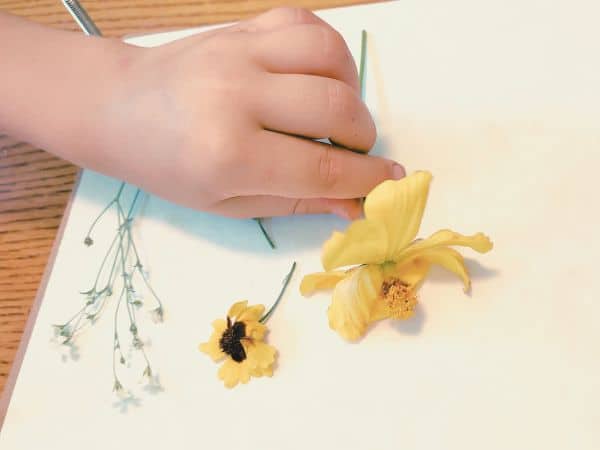
- Trim stems and arrange the flowers exactly how you want them to look when flat.
- Layer in your press: cardboard → blotting paper/parchment → flowers → blotting paper → cardboard.
- Stack, tighten the screws or straps, and store in a dry, dark spot for 3–4 weeks.
- Resist the urge to peek too often—the magic happens when you wait!
Pressing flowers is relatively easy. You’ll figure out which kinds press easier than others. Very thick ones aren’t always worth the effort and can be a struggle to keep flat as you tighten the press while others are extremely easy. Now let’s get into the crafting part!

Making Dried Flower Bookmarks
Once you have pressed, dried flowers there are many different ways to use them! Things to consider is your family’s attention spans and how much you’re willing to commit (time and mess). Dried flower bookmarks are my go to because my boys are young and I prefer easy activities that could potentially end in tears. You’ll find an additional list of activities below that use fresh and pressed flowers. The fun doesn’t have to start or end with these dried flower bookmarks!
Materials Needed for Bookmarks
The following are the essentials for our family to make bookmarks but you can certainly forego adding a ribbon at the end of the activity. Also, you can try other ways to laminate. When I was a child a simple home laminator was not easy to come by so I used packing tape. It’s the right width for a bookmark but you do have to be more careful of air bubbles.
- A good flower press, as mentioned above, or some old, heavy encyclopedia books.
- Extra cardstock and parchment paper for backups.
- Fresh flowers and a variety of leaves.
- A home laminator and pouches.
- Sharp scissors, a hole punch, and ribbon.

Step-by-Step Guide for the Prettiest Flower Bookmarks
Once the flowers are crisp and flat, the real fun begins:
- Open the press together and let everyone ooh and aah.
- Place a laminating pouch on the table.
- Let your child arrange the flowers however their heart desires (leave the leading edge mostly empty so it feeds into the machine smoothly).
- Carefully lay the top sheet down and smooth making sure the flowers and stems stayed put.
- Feed it through the laminator slowly—adult job, but kids can gently pull from the other end.
- Trim each bookmark, leaving about ¼ inch of clear border all the way around.
- Punch a hole at the top and tie on a cheerful ribbon tassel.
The result? A bookmark that is perfect for gifting and holds precious memories between every page. I guided my children on the first few to give them an idea of how wide a bookmark should be, you can also use a marker to create guidelines for their creation to stay within. My boys quickly caught on and were making pretty designs with petals that may have fallen off and adding extra greenery that we had pressed.

Creative Twists and Personalization Ideas
Let your kiddos get extra creative with the following ideas or try their own experiments. This craft could inspire and motivate your child to keep trying different techniques and press flowers all during the growing months (or even get into fall leaves!)
- Add a pressed fern or leaf as a “stem” for a mini bouquet effect.
- Write a short Bible verse, quote, or the child’s name in permanent marker after laminating.
- Sprinkle separated petals for a whimsical effect, and to keep any of your flower pressing efforts from going to waste.
- Make double-sided bookmarks by arranging flowers facing up and down.
- Draw a quick bee or ladybug with a fine-tip pen for extra whimsy.

Troubleshooting Your Pressed Flowers
When it comes to a simple child’s craft not much can go wrong, yet here are some common things we have encountered when pressing flowers. Ultimately though the best way to learn is to try and fail so don’t be afraid to try that thick, beautiful cream dahlia flower. We did and weren’t able to use it, yet it was still fun to try!
- Brown edges → flowers were picked too late in the day or were already wilting.
- Mold spots → not enough airflow; change blotting paper halfway through next time.
- Wrinkles → flowers were too thick or overlapping too much.
A Year-Round Flower-Pressing Calendar
Don’t think that your flower press can only be brought out in summer! Here are some ideas to keep the pressing going year round, plush a wonderful way to use them if you don’t want to bust out the laminator every time.
- Spring: violets, pansies, forsythia, lilacs, bleeding hearts
- Summer: cosmos, zinnias, daisies, lavender, queen anne’s lace
- Fall: marigolds, chrysanthemums, colored fall leaves, dried hydrangeas
- Winter: grocery-store alstroemeria, carnations, statice, or evergreen sprigs

Keeping a Monthly Flower-and-Leaf Journal
One of the sweetest offshoots of flower pressing is starting a simple monthly nature journal—it turns random walks into treasure hunts and gives every pressed flower a permanent story. This is a great way to see the beauty God’s creation offers us year round.
Here’s how to do it:
- Grab a plain sketchbook or a half-size three-ring binder (the smaller size preferably).
- Once a month, head outside—no matter the weather—with a little basket and scissors.
- Everyone finds at least one flower, leaf, seed pod, or interesting twig that says “this is what right now looks like.” Even in January we can usually find moss, holly, or pine needles.
- Back home press the finds in the flower press.
- Once the new finds are in the press, the kids:
- Glue or tape last month’s pressed pieces onto a fresh page in the journal
- Draw a quick picture of where we found it (a crooked fence, the muddy trail by the creek, a bush from the lane)
- Write the date, the name of the plant if we know it (or take time researching in a field guide), and one sentence about the day: “We sneezed the whole time because of ragweed.”
- Let your child add the temperature, weather, or a feather.
That’s it—ten or fifteen minutes once a month to track earth’s cycles in a nature journal.
The magic happens when they flip back and see March’s tiny green maple leaves next to October’s fiery red ones, or when they spot the same patch of clover blooming again a year later. They start noticing seasons in a deeper way, remembering which neighbor’s yard had the best daisies, and lighting up when it’s time to pull out the nature journal.

3 Super Easy Flower Crafts
Once you have a pile of fresh flowers (from your garden, a neighbor, or the grocery store), these five activities need nothing else except the blooms themselves and a little imagination. They’re perfect for a spontaneous flower-filled afternoon.
- Classic Flower Crowns Pick long-stemmed flowers like daisies, clover, dandelions, or cosmos. Show your child how to split the stem with a thumbnail and thread the next flower through, chaining them into a circle. Twenty minutes later everyone is wearing a crown fit for woodland royalty—no wire, tape, or glue required.
- Color-Changing Carnations Fill a few clear glasses with water and add a generous squirt of food coloring to each (blue, red, purple, even black for drama). Trim the ends of white carnations or daisies and stand one in each glass. By the next morning the petals have “drunk” the color and transformed into living rainbows—instant wow-factor science.
- Flower Petal Mandalas Sit in a circle on the grass or a blanket and take turns placing single petals into a beautiful symmetrical pattern. Use different colors and sizes (marigolds, zinnias, and rose petals work beautifully). When it’s finished, snap a photo—then let the wind scatter it back to the earth. It’s mindful, temporary art that teaches pattern and impermanence.
These five keep the focus entirely on the flowers themselves—celebrating their colors, scents, and fleeting beauty while giving kids full permission to play, experiment, and get wonderfully petal-covered in the process!

Nature Crafts You’ll Love
If flower pressing has your family hooked on bringing the outdoors in, try Pinecone Bird Feeders and a week of bird-watching, Apple Stamping Art, Leaf Art Rubbing, or painted kindness rocks for the garden.
Flower pressing is one of those rare activities that works just as beautifully on a relaxed Saturday as it does woven into a month-long homeschool unit. It’s quiet, inexpensive, and ends with a little piece of summer you can revisit each time you open a book. They’re also great gifts for grandparents or friends!
So grab a handful of flowers, tighten the press, and get ready for your kids to fall deeper in love with nature—one perfectly pressed petal at a time. Share in the comments below how you use pressed flowers in crafts with your kids to inspire another momma!
Dried Flower Bookmark
AT A GLANCE ACTIVITY INSTRUCTIONS
Materials
- Freshly picked flowers
- Flower press
- Laminator
- Laminator sheets
- Hole punch
- Ribbon
Instructions
- Gather flowers from your backyard, permission from a neighbor, or from the grocery store.
- Press the flowers in a flower press.
- After 3-4 weeks remove the dried flowers and arrange in laminator sheets.
- This arrangement should be narrow to look like a bookmark.
- Also when placing in the sheet, keep the end that will go in first clear of flowers so that it easily feeds through. Then once you can grab a hold of it, keep tension on the sheet to assist the rest of the way.
- Cut around the individual bookmarks, leaving about a quarter of an inch side. At the top be sure to leave enough room for a hole punch.
- Hole punch that spot and tie a ribbon on.
Recent Posts on the Blog