
This post may contain affiliate links. Please refer to our disclosure policy.
Music isn’t just about notes and rhythms—it’s about creating joy, building skills, and making memories that last a lifetime. As the holiday season rolls around, there’s nothing quite like filling your home with the sounds of easy Christmas songs. These timeless tunes are perfect for kids, whether they’re just starting out on the piano, strumming a guitar, or simply singing along with gusto.
Table of Contents

If you’re looking for ways to get your little ones excited about music this winter, you’ve come to the right place. Christmas songs are a fantastic entry point because they’re catchy, repetitive, and full of festive cheer. Plus, they’re often simple enough for beginners to master quickly, boosting confidence and encouraging more practice. Here, we’ll dive into why teaching kids these carols is so beneficial, take a quick trip through the history of Christmas itself, and then spotlight some of the easiest secular songs and hymns out there.
Whether you’re prepping for a family sing-along, a school recital, caroling at a local senior center, or just sharing some festive cheer while driving, these easy Christmas songs will have everyone humming along in no time. Let’s get into the holiday spirit!

Why Teach Kids Christmas Carols
Teaching kids Christmas carols isn’t just about getting them ready for the holidays—it’s a smart, fun way to nurture their overall development. First off, music education has been shown to enhance cognitive skills like memory, attention, and problem-solving. When children learn simple melodies and lyrics, they’re exercising their brains in ways that spill over into math, reading, and even emotional regulation. For instance, repeating phrases in songs like Jingle Bells helps with pattern recognition, which is a foundational math skill.
On a practical level, Christmas carols are ideal for beginners because they’re often in major keys with straightforward rhythms. This makes them less intimidating than complex pieces, allowing kids to experience success early on. Imagine your child beaming with pride after nailing their first full song on the keyboard— that’s the kind of motivation that keeps them coming back to practice. Plus, these songs are seasonal, so they feel special and tied to family traditions, making practice feel like play rather than a chore.
From a social perspective, carols bring people together. Singing or playing as a group fosters bonding, whether it’s with siblings in the living room or friends at a holiday party. It teaches teamwork, listening skills, and empathy—after all, harmonizing requires paying attention to others. And let’s not forget the cultural aspect: Christmas music connects kids to a broader heritage, helping them appreciate diversity in traditions from around the world.
Emotionally, these tunes can be a stress-reliever during the busy holiday season. Music releases endorphins, and belting out a cheerful carol can turn a grumpy afternoon into a joyful one. This can especially be needed in locations where the sun disappears for a few months in the winter.
Finally, incorporating easy Christmas songs into lessons builds lifelong habits. Kids who start with fun, accessible music are more likely to stick with instruments long-term. Overall, let’s make this holiday season musical – with or without an instrument!

The History of Christmas
Christmas, celebrated on December 25th, has a rich tapestry of origins that blend religious significance with ancient pagan customs. While today it’s primarily known as the Christian holiday marking the birth of Jesus Christ, its roots go back much further. Early Christians didn’t celebrate Jesus’ birth until the 4th century, when Pope Julius I chose December 25 to coincide with existing winter festivals, effectively Christianizing them.
One key influence was the Roman festival of Saturnalia, held from December 17-23, which honored the god Saturn with feasting, gift-giving, and role reversals—think servants being served by their masters. This merry-making spirit carried over into Christmas traditions. Similarly, the Germanic Yule festival celebrated the winter solstice with log-burning, evergreen decorations, and feasts to welcome longer days. These elements, like the Yule log and wreaths, symbolize renewal and light in the darkest season.
By the Middle Ages, Christmas had evolved in Europe with church services, nativity plays, and caroling door-to-door singing that started as wassailing, a toast to health with spiced ale. The Renaissance brought more structured celebrations, but it wasn’t until the 19th century that modern Christmas took shape, thanks to Victorian influences. Queen Victoria and Prince Albert popularized the Christmas tree, a German custom from the 16th century where evergreens were adorned with candles and fruits.
Santa Claus himself draws from St. Nicholas, a 4th-century bishop known for secret gift-giving, blended with Dutch Sinterklaas and British Father Christmas. The jolly, red-suited version we know was solidified in the 1800s through poems like “A Visit from St. Nicholas” (1823) and Coca-Cola ads in the 1930s.
In America, Christmas was initially subdued—Puritans even banned it in the 17th century for being too pagan—but by the 1800s, it became a family-centered holiday with stockings, trees, and songs. Today, global traditions vary: Mexicans celebrate Las Posadas, Swedes honor St. Lucia with candle crowns, and Australians enjoy beach barbecues. Yet, Christmas music remains a universal thread, tying these diverse customs together.
Understanding this history adds depth to teaching kids Christmas songs, showing how melodies have evolved from ancient chants to modern hits, reflecting humanity’s enduring need for joy and community during winter’s chill.
Read Next: Christmas In Your Homeschool

Secular Christmas Songs
Here’s a full list of some delightful secular Christmas songs that are easy for kids to learn. These focus on fun, non-religious themes like Santa, reindeer, and winter magic. I’ve included dates of writing or popularization where available, along with why they’re great for beginners. Additionally, if you’re interested in the lyrics to these songs then check out Altogether Christmas, this resource is great with it’s list of songs, lyrics, and audio option.
- We Wish You a Merry Christmas (16th century, popularized 1930s): This lively English folk carol, rooted in the 1500s West Country tradition, became widely known through 1930s recordings. Its cheerful demand for “figgy pudding” and good tidings (“We wish you a Merry Christmas and a Happy New Year”) in G major uses simple, repetitive phrases perfect for kids.
- Up on the Housetop (1864): Written by Benjamin Hanby in 1864, this upbeat tune describes Santa’s rooftop adventures and gift deliveries. It’s perfect for kids because of its simple, repetitive melody in the key of G major. Start by teaching the lyrics: “Up on the housetop, reindeer pause / Out jumps good old Santa Claus.”
- Here Comes Santa Claus (1947): Penned and popularized by Gene Autry in 1947, this song captures the excitement of Santa’s arrival with jingle bells and ho-ho-hos. Its straightforward structure—verse-chorus-repeat—makes it ideal for young learners. In C major, the melody uses mostly stepwise motion, avoiding big jumps. Lyrics like “Here comes Santa Claus, right down Santa Claus Lane” are fun to act out. Kids love the energy, which encourages expressive playing.
- Rudolph the Red-Nosed Reindeer (1939, popularized 1949): Based on a 1939 story by Robert L. May, the song was written by Johnny Marks and hit big with Gene Autry’s 1949 recording. This narrative tune about the underdog reindeer is empowering for kids, with a catchy chorus in G major. The melody has some leaps but is repetitive, aiding memorization. Teach lyrics: “Rudolph the red-nosed reindeer had a very shiny nose.”
- Frosty the Snowman (1950): Created by Walter “Jack” Rollins and Steve Nelson in 1950, and recorded by Gene Autry, this whimsical song tells of a magical snowman coming to life. In C major, its bouncy rhythm and simple intervals make it beginner-friendly. Lyrics: “Frosty the Snowman was a jolly happy soul.” This song teaches tempo changes, as it speeds up in excitement.
- Jingle Bells (1857): Originally titled “One Horse Open Sleigh,” written by James Lord Pierpont in 1857 for Thanksgiving but became a Christmas staple. Its lively D major melody is all about sleigh rides and bells, with easy repetition. Kids adore the “jingle all the way” chorus.
- The Twelve Days of Christmas (1780, popularized early 20th century): This English folk carol, first published in 1780, gained popularity through early 1900s arrangements. Its cumulative structure, listing gifts from “a partridge in a pear tree” to “twelve drummers drumming,” makes it fun and memorable for kids, despite its length. Teach it phrase-by-phrase, focusing on the counting aspect to engage young learners.
- Santa Claus is Coming to Town (1934): Written by J. Fred Coots and Haven Gillespie in 1934, popularized by Eddie Cantor. This warning-turned-fun song in C major has a swinging feel. Lyrics: “You better watch out, you better not cry.” Easy for kids with its call-and-response style.
- Deck the Halls (16th century, popularized 1862): This festive carol, based on a Welsh melody from the 1500s called “Nos Galan,” was paired with English lyrics in 1862 by Thomas Oliphant. Its upbeat call to “deck the halls with boughs of holly” in F major features a lively, repetitive melody perfect for kids. The “fa la la la la” refrain is a fun vocal hook that encourages group singing.

Contemporary Christmas Songs
Here are a few more modern, easy-to-learn Christmas songs that add a fresh twist to your holiday playlist. These are great for kids due to their catchy hooks, simple lyrics, and upbeat vibes—perfect for piano sing-alongs or family jam sessions.
- Candy Cane Lane (2017): Sung by Sia, this sparkling pop track from her Everyday Is Christmas album paints a vivid picture of a twinkling holiday street lined with treats and lights. Its repetitive chorus (“Dancin’ in the moonlight on Candy Cane Lane”) is super simple in C major, that beginners can strum on guitar or plink on keys. Kids will love the whimsical imagery!
- You’re a Mean One, Mr. Grinch (1966, popularized in modern covers like Lindsey Stirling’s 2017 violin version): From the classic How the Grinch Stole Christmas!, this sassy, jazz-infused rant against the green grouch has seen fresh life in contemporary arrangements. The original’s cheeky lyrics (“You’re a mean one, Mr. Grinch / You really are a heel”) in E minor make it easy for kids to sing along with – and they’ll love the hilarious lyrics. Modern twists add holiday flair and challenges for playing on instruments.
- All I Want for Christmas Is You (1994, revived in 2020s pop culture): Mariah Carey’s iconic bop, which exploded again via TikTok and holiday playlists, is all about simple joys and puppy love under the mistletoe. The joyful chorus in G major uses straightforward stepwise notes, perfect for young singers or keyboard newbies. Lyrics like “I don’t want a lot for Christmas / There is just one thing I need” are relatable and repetitive.
- Underneath the Tree (2013): Kelly Clarkson’s bubbly hit from her Wrapped in Red album captures the thrill of ripping open presents with a retro-soul groove. In A major, the melody bounces with easy intervals, making it guitar-friendly, and ideal for piano duets where one hand handles the bass. Sing-along lines (“You’re here where you should be / Present for Christmas”) encourage family harmonies.
- Mistletoe (2011): Justin Bieber’s feel-good debut holiday single evokes stolen kisses and snowy walks, with a reggae-pop rhythm that’s infectious for little ones. Set in D major, its call-and-response structure (“Kiss me underneath the mistletoe”) simplifies learning on the piano. The lighthearted romance (kid-safe version: focus on the fun!) makes it great for group echoes.
These Christmas song picks blend nostalgia with today’s sound, keeping things light and accessible. Slot them into your secular songs section for that modern edge!

Christmas Hymns
Shifting to the reason for the season we’re now exploring more spiritual tunes, these Christmas hymns are serene and meaningful, often easier for their slower paces. With many hymns there are multiple verses where the lyrics change but the melody remains the same. This means that on an instrument the music remains the same but the words will change every time the song is repeated (except for the chorus of course). For younger kids focus on singing the first verse and chorus. Slightly older, the first and last verse are great options. Lastly, for older kiddos try singing and memorizing all verses.
- Away in a Manger (1885): Lyrics first appeared in 1885, with music by William J. Kirkpatrick in 1895, though sometimes attributed earlier. This lullaby-like hymn in F major depicts baby Jesus in the stable. Its gentle melody is perfect for beginners, with smooth, stepwise notes. Lyrics: “Away in a manger, no crib for a bed.”
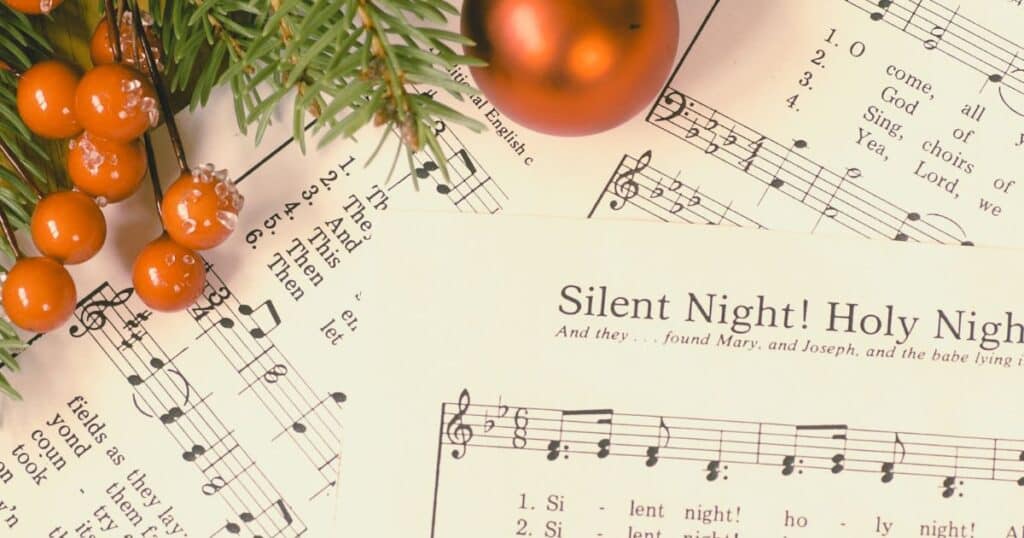
- Silent Night (1818): Composed in 1818 by Franz Gruber with lyrics by Joseph Mohr in Austria. In Bb major, this peaceful carol has a waltz-like flow, easy for kids with its repetition. Lyrics: “Silent night, holy night.” This Christmas song evokes calm and is great for reflective moments.
- Joy to the World (1719, music 1839): Lyrics by Isaac Watts in 1719, set to music by Lowell Mason in 1839. Triumphant in D major, it’s energetic yet simple with descending scales. Lyrics: “Joy to the world, the Lord is come.” Use this Christmas song for tempo building, adding joy to lessons.
- Do You Hear What I Hear? (1962): Written by Noël Regney and Gloria Shayne during the Cuban Missile Crisis, this song carries a message of peace through imagery of a lamb, star, and king. First recorded by the Harry Simeone Chorale in 1962, its gentle, narrative melody in C major is accessible for kids, with smooth, stepwise notes and simple chords. Lyrics like “Do you hear what I hear? / A song, a song, high above the trees” encourage storytelling through music.
- Hark! The Herald Angels Sing (1739): Lyrics by Charles Wesley in 1739, music by Felix Mendelssohn in 1840. In G major, its majestic melody has some leaps but is rewarding. Lyrics: “Hark! The herald angels sing.”
- O Holy Night (1847): Music by Adolphe Adam in 1847, based on an 1843 poem. In C major, this slower pace suits beginners, with emotional builds. Lyrics: “O holy night, the stars are brightly shining.” This Christmas song is great for advancing beginners.
- O Come All Ye Faithful (1743): Attributed to John Francis Wade around 1743. In G major, this Christmas hymn is inviting and march-like tune. Lyrics: “O come all ye faithful.”

Tips for Teaching Christmas Songs
To make learning easy Christmas songs a breeze, here are some practical, step-by-step tips for you and your family.
- Start Slow and Break It Down: Begin by dividing the song into small phrases or sections. Have kids master one part at a time before stringing them together—this builds confidence without overwhelming them.
- Use Visual Aids for Engagement: Incorporate colored notes, stickers on piano keys, or music apps with interactive visuals to make learning more fun and memorable for visual learners.
- Incorporate Rewards and Incentives: Celebrate small wins with stickers or holiday treats to keep motivation high and turn practice into a positive experience.
- Turn Lessons into Games: Make it playful by transforming songs into activities, like turning “Rudolph” into a freeze dance where kids stop moving when the music pauses, or adding actions to lyrics for kinesthetic learning.
- Emphasize Patience and Repetition: Remind yourself (and the kids) that repetition is key to mastery -practice the same section multiple times in short bursts to avoid frustration and reinforce muscle memory.
- Demonstrate and Guide Hands-On: Always model the song first on the instrument, then guide the child’s hands or fingers directly to help them feel the movements, fostering a tactile understanding.
- Supplement with Online Resources: Use free online tutorials or videos as helpers, but pair them with your personal encouragement and feedback for the best results -nothing beats one-on-one interaction.
- Adapt to Their Pace and Interests: Watch for signs of fatigue and adjust; if a song isn’t clicking, switch to another or simplify it further to match their skill level and keep the joy alive.
- Encourage Group Practice: Involve siblings or family members in duets or harmonies to build social skills and make sessions more enjoyable through collaboration.
Read Next: Gifts for Homeschoolers

Easy Instruments to Start With
Simply singing these songs during the month of December is special and can lead to many beautiful memories. But maybe your child shows an aptitude for music, opt for an instrument that has no complexity to it or playing it, the xylophone is an awesome option for kids who aren’t quite ready for the commitment of a larger and more complicated instrument. If your child is 5 or older they may be ready for a bigger challenge. Seven is the usual beginner’s age for starting piano, but you can begin earlier depending on your child’s maturity and fine-motor skills. All my boys have started piano lessons at age 5, or even earlier because they showed a great interest.
Piano is great for visuals and no tuning is necessary on a regular basis (buy a keyboard and you won’t have to worry about tuning at all). But overall, what’s great about a piano is that the notes and keys match directly. The ukulele offers portability with four strings, easy for small hands; chords like C and G cover many songs. Lastly, a guitar for an older child. Preferably this child has already had experience on the piano to learn the basic structure of notes and reading music. Choose based on age and interest for sustained engagement.

Fun Activities Around Christmas Music
Take your Christmas music beyond practice with these engaging activities that blend creativity, community, and holiday spirit.
- Host a carol karaoke night with homemade props like microphones or festive hats to encourage silly performances and laughter.
- Create a “song advent calendar” where each day reveals a new tune or lyric sheet, building anticipation throughout December.
- Organize a neighborhood caroling walk, bundling up and going door-to-door with printed lyric sheets; enlist friends or family to join in, turning it into a group adventure that spreads cheer and builds social connections.
- For a heartwarming twist, plan caroling at a local senior center – coordinate with the facility ahead of time, bring simple instruments like shakers or bells, and invite residents to sing along, fostering intergenerational bonds and teaching kids about giving back.
- Craft homemade instruments from recyclables, such as bottle-cap tambourines or rubber-band guitars, to accompany your songs and spark imagination.
These activities not only reinforce the Christmas music but also create lasting family traditions filled with joy, togetherness, and building community connections.
Read Next: Holiday Book Rotations

Spark Holiday Cheer
Overall, remember that the true magic of learning easy Christmas songs lies in the shared moments they create. Whether belting out secular favorites or humming heartfelt hymns, these tunes bring warmth and wonder to the season. So grab an instrument, gather the family, and let the music play or voices be heard.
Recent Posts on the Homeschool Blog