COLOR MIXING ACTIVITIES
Mixing primary colors for kids.
— By Julie Hodos on November 25, 2024; Updated on December 29, 2025.
This post may contain affiliate links. Please refer to our disclosure policy.
Your little one finally knows “red,” “blue,” and “yellow” without hesitation. They point at the sky and shout “blue!” and get ridiculously excited when they spot their favorite yellow digger at the park. Huge win, right? But now they’re ready for the next level of color magic, and it’s honestly one of the most fun things you’ll ever teach them: mixing primary colors to create brand-new ones. Watching their eyes go wide the first time yellow + blue suddenly turns into green is pure parenting gold.
Table of Contents

Today I’m giving you everything you need to make this concept stick—without it feeling like a “lesson.” We’re talking messy, joyful, giggle-filled activities that your kids will beg to do again and again. By the end you’ll have a full game plan (and a secret weapon activity that practically guarantees they’ll never forget the difference between primary and secondary colors).
Ready? Let’s make some color magic!
Why Should Your Child Learn About Mixing Primary Colors?
Introducing colors by mixing primary colors is an excellent way begin an introduction to color theory in art. It lays a strong foundation for understanding primary and secondary colors, to then lead into all different tones, shades, and tints.
- Future Art Confidence – Once kids understand they can make any color they want with just red, yellow, and blue, they stop saying “I don’t have the right color!” and start problem-solving. That’s huge for creativity.
- Early Science & Math Thinking – Mixing colors is basically kitchen chemistry. They’re experimenting, predicting, observing cause and effect—all those fancy STEM words we love.
- Resourcefulness – They learn they don’t always need to buy the “perfect” supply. No orange marker? No problem—we’ll make it!
- Connection to Nature – Rainbows, sunsets, flowers, peacocks… suddenly your child sees that nature itself is the ultimate color-mixing artist using those same three primary colors (well, technically light uses additive primaries, but we’ll keep it simple for preschoolers).
- Fine Motor + Patience Practice – Squeezing droppers, layering colored pencils carefully, waiting for paper towels to “grow” a rainbow—these all build little hands and attention spans.
Read Next: All About Rainbows for Kids

The Super Simple Breakdown: Primary vs. Secondary Colors
Primary colors = the three boss colors that cannot be made by mixing anything else:
🔴 Red
🟡 Yellow
🔵 Blue
Secondary colors = the three colors you get when you mix two primaries together:
🟠 Red + Yellow = Orange
🟢 Yellow + Blue = Green
🟣 Blue + Red = Purple
That’s it. Six colors total. But from those six come every single other color in the universe.
Pro tip for parents: We’re talking subtractive color mixing here—the kind you get with paint, markers, food coloring. Light mixing is different (red + green = yellow), but save that for upper elementary. Keep it simple now!

Picture Books About Primary Colors
Want to reinforce everything they’re discovering with paint and colored water? Snuggle up with one of these books—they’re our family’s absolute favorites for teaching primary and secondary colors without ever feeling like a lesson.
- Mouse Paint by Ellen Stoll Walsh Still the undisputed champion. Three white mice hop into red, yellow, and blue paint and mix every secondary color. Simple, perfect, requested on repeat.
- Mix It Up! by Hervé Tullet Interactive genius—press here, shake the book, smush the page… and colors magically blend. The gray page (all three primaries together) blows little minds every single time.
- Usborne Big Book of Colors This oversized treasure is a total show-stopper. Every single spread is packed with real-life photographs, flaps to lift, color wheels, transparent overlay pages that let you mix colors right on the book, and clear explanations of primary vs. secondary (and even tertiary!) colors. It’s the closest thing to doing the water-drop experiment inside a book. My kids fight over who gets to turn the see-through mixing pages. Worth every penny and perfect from age 2–7.
- Monsters Love Colors by Mike Austin Rowdy. Scribble. Mix! Energetic monsters turn primary colors into a wild rainbow party. Loud and hilarious—ideal for wiggly kids.
- Little Blue and Little Yellow by Leo Lionni Two color blobs hug and become green. A classic that’s gentle, abstract, and surprisingly emotional.
- White Rabbit’s Colors by Alan Baker Sweet, simple, and straight to the point: Rabbit spills paint and discovers what red + yellow makes, etc. Great for toddlers.
- Planting a Rainbow by Lois Ehlert Gorgeous cut-paper flowers in every hue. We love pointing out how real flowers follow the same mixing rules.
- Sky Color by Peter H. Reynolds Marisol has to mix her own blue when the paint runs out—quietly drives home that blue is a primary color that can’t be created from anything else.
- The Day the Crayons Quit by Drew Daywalt Not strictly a mixing book, but sneaky color theory + hilarious crayon drama. Kids suddenly notice orange and purple are “made” colors.
- A Color of His Own by Leo Lionni Beautiful story about a chameleon who wants one permanent color—leads to great talks about blending and changing.
I love reading these unit-themed books during morning basket before we actually get to the mixing activities. If morning isn’t best for you then an evening bedtime story is the perfect time to fit one of these read alouds in.

11 Activities for Mixing Primary Colors
Pick the one that sounds the best for you and your kiddos. Spread them over a week or a month, repeat any that become favorites. The more you mix, the deeper the understanding.
Classic Water Mixing Demonstration
Easy, virtually free, and uses supplies you have in your pantry.
Materials
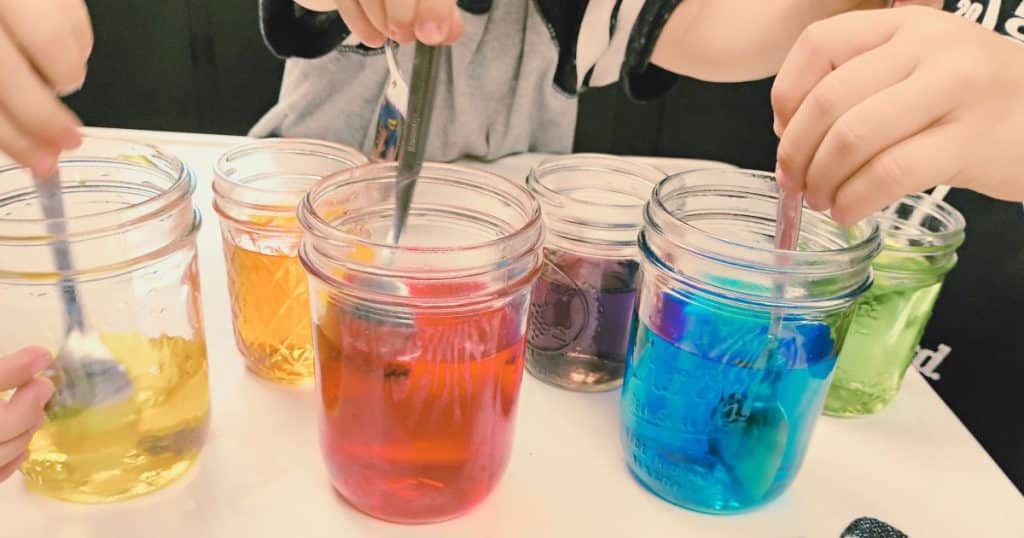
- 6 clear glasses or jars
- Food coloring (red, yellow, blue)
- Spoons or droppers (droppers = extra fun)
- Water
- Optional: tray or towel for spills (there will be spills, embrace it)
How to Do It
- Fill three glasses with water. Let your child add 5–10 drops of one primary color to each glass. Stir.
- Say the magic words: “These are the three primary colors. They’re special because nothing makes them—they make everything else!”
- Set out three empty glasses.
- Pour yellow water into two of them first (yellow gets “dirty” easily).
- Add blue to one → watch green appear!
- Add red to the other → hello orange!
- Finally, mix red + blue in the last glass → purple!
Let them go wild after the demonstration. My boys had a blast experimenting with pouring and mixing colors. We talked about muddy brown (all three mixed), purple (lots of red + tiny bit of blue in lots of water), why you only need a little of red and blue when mixing with yellow. So many teachable moments!

Color Mixing Paddles (Zero Mess Magic)
Perfect for quick and super easy lessons like when you’re too tired for cleanup but want to review primary and secondary colors.
Materials
All you need is a set of simple color paddles that can be found at the link. It helps to have good lighting as well to backlight the paddles.
How to Use
Hold red + yellow up together → orange appears!
Overlap blue + red → purple!
Yellow + blue → green!

The Coloring Restriction Challenge
This is the activity that made my son truly understand. I saw everything click, especially when he didn’t have green for a favorite cartoon character whose main color was green.
Day 1: Print or pull out a coloring page of their current obsession (Bluey, Spider-Man, unicorns, whatever).
Give them only red, yellow, and blue colored pencils.
When they say “I need green for the grass!” you smile and say, “You have everything you need to make green. Figure it out.”
Watch the light bulb go on when they color yellow first, then lightly layer blue over it. Magic.
Day 2: Give them only orange, green, and purple pencils.
Now when they need blue sky, they realize… they can’t make blue from secondary colors. That’s when they get it: primary colors are the bosses.
This activity creates real cognitive dissonance in the best way. They feel so proud when they solve it themselves.
(Use colored pencils, not crayons or markers. Pencils layer best without tearing paper.)

Prism Rainbow Exploration (Science + Beauty)
Materials
You need sunshine or a flashlight with a concentrated light beam and a prism (or even a glass of water on a sunny windowsill works in a pinch).
Steps
- Darken the room slightly.
- Let sunlight hit the prism and cast a rainbow on the wall or floor.
- Use the ROYGBIV but combine indigo/violet into “purple” for simplicity → ROY G B P
- Point out: Red, Yellow, Blue = primary! Orange, Green, Purple = secondary!
We have a free printable rainbow with just 6 bands (perfect for younger kids) and a 7-band version for older ones over on the post, Rainbows for Kids.
Kids go nuts trying to “catch” the rainbow or seeing it dance across their arms. This activity is great to inspire awe as your child creates their own rainbow.

Grow a Rainbow
This one never gets old but does take a bit a prep work. I was pleasantly surprised at how it captivated my boys’ attention even though it’s a slow process that requires patience.
Materials
- Paper towels
- Washable markers
- Two small bowls of water
How to Do It
Cut down a paper towel. Color the shorter opposite ends with markers, colors should mirror each other and follow the pattern red, orange, yellow, green, blue, purple, red. Be sure to only do the sections at the end, leaving white in the middle for the colors to travel up and meet. Bend into a U shape and put ends in two bowls of water. Watch the colors climb and meet to form secondary colors in the middle!
This is one we have repeat because it’s magical every single time.

Finger Painting with Primaries
Get ready for some gloriously messy creativity that lets kids feel the colors blending under their fingertips.
Materials
- Finger paints in red, yellow, and blue
- Large sheet of paper or butcher paper taped to the floor/table
- Smocks or old clothes (this gets everywhere!)
- Washcloths for stray paint smears
How to Do It
- Squirt dollops of each primary color onto the paper.
- Explain: “We only have red, yellow, and blue today. Let’s see what happens when we smoosh them together!”
- Let them dive in—swirling red and yellow to make orange handprints, blue and yellow for green finger trails, etc.
- Talk about what they discover: “Look, that purple came from red and blue!”
- Extend by challenging them to make a whole picture (like a sunset or garden) using only mixed colors.
This is sensory heaven for toddlers and builds fine motor skills while they explore textures and blends. My kids ended up with rainbow arms, but the joy was worth the bath time!

Shaving Cream Color Clouds
Turn a simple tray into a cloud-like canvas for low-mess (sort of) color experimentation.
Materials
- Shaving cream (unscented, white foam kind)
- Food coloring (red, yellow, blue)
- A large tray or baking sheet
- Droppers or spoons
- Optional: toothpicks or sticks for swirling
How to Do It
- Spray a thick layer of shaving cream into the tray to make “clouds.”
- Let your child add drops of primary colors on top.
- Use fingers or tools to swirl and mix: Watch yellow + blue puff into green clouds!
- Discuss: “What secondary color did we just make? Can we make it lighter or darker?”
- Play until it’s a big, foamy rainbow mess—then rinse and repeat.
It’s like finger painting but fluffier and a different sensory feel. Kids love this aspect of it!

Ice Cube Painting (Chilly Color Melts)
Combine art with a cool science twist as frozen colors melt and blend on paper.
Materials
- Ice cube tray
- Water mixed with food coloring (red, yellow, blue)
- Craft sticks or popsicle sticks (for handles)
- Watercolor paper or thick cardstock
How to Do It
- Freeze primary-colored water in the tray overnight (add sticks for easy gripping).
- Pop out the ice cubes and let kids “paint” by rubbing them on paper.
- As they melt and overlap, colors mix: Red ice over yellow makes orange puddles!
- Chat about: “Why is the green appearing where blue and yellow meet?”
- Let the artwork dry for a watercolor-like effect.
This adds a temperature element—cold ice on warm paper—and teaches about states of matter alongside colors. Perfect for hot days!
Read Next: Forms of Water for Kids
Playdough Color Combining
Hands-on dough play that lets kids mold their own color discoveries.
Materials
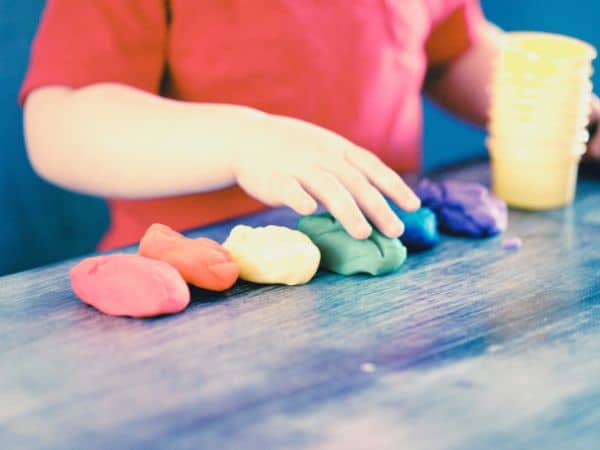
- Homemade or store-bought playdough in red, yellow, and blue (easy recipe: flour, salt, water, oil, food coloring)
- Rolling pins, cookie cutters, or just hands
- Plastic mat or table for easy cleanup
How to Do It
- Give each child balls of the three primary colors.
- Encourage kneading two together: “What happens if we squish red and yellow?”
- Watch orange emerge, then try the others for green and purple.
- Build sculptures using mixed colors: A green snake, purple flower, etc.
- Eventually the primary colors will disappear leading to a deeper discussion: “Why can’t we unmix the colors? What makes primaries special?”

Daisy Petal Coloring
A plant-based experiment showing how colors travel and blend in nature.
Materials
- White daisies with stems
- Clear glasses of water
- Food coloring (red, yellow, blue)
- Knife (adult use) to split stems
How to Do It
- Add primary colors to separate glasses of water.
- Place split stems in separate glasses – observe with patience the climbing of the water, dying the petals.
- Explain: “Plants mix colors like we do—see the secondary purple in red + blue?”
This ties into biology (capillary action) and shows real-world color mixing.

Magic Milk Swirls (Dish Soap Spectacle)
A quick wow-factor demo with swirling secondary colors.
Materials
- Shallow dish or plate
- Whole milk
- Food coloring (red, yellow, blue)
- Dish soap
- Cotton swabs
How to Do It
- Pour milk into the dish.
- Add drops of primary colors around the surface.
- Dip a soap-soaked swab in the center—watch colors burst and mix into secondaries!
- Swirl gently: “Look, orange from red and yellow dancing together!”
- Repeat with fresh milk for more experiments.
It’s like fireworks in a plate, teaching about surface tension too. Inexpensive and mesmerizing.
Read Next: 20+ Rainbow Activities for Kids
The Ultimate Test: Do They Really Understand?
After several activities, casually ask while painting or playing:
“Hey, if I only had red and blue paint, could I make green?”
If they confidently say “No, I need yellow!” — congratulations. They get it.
Or try the coloring restriction coloring page challenge again in a month. If they immediately start layering without prompting, your efforts have been successful.

Continue the Learning
You don’t need fancy materials or perfect execution. You just need you, your kid, and a willingness to get a little messy. Pick one activity. Do it this week. Then come back and try another. Don’t forget to read a picture book or two aloud! Then watch your little artist (and scientist) bloom right before your eyes. Drop a comment and tell me which activity you try first—I read every single one.
Don’t stop the learning about colors now, take it a step further and explore colors as they pertain to the rainbow here at this post, All About Rainbows.
Recent Posts on the Blog