OLD FASHIONED NOSTALGIC FUN
16 old outdoor games to play with your kids.
— By Julie Hodos on April 18, 2025

This post may contain affiliate links. Please refer to our disclosure policy.
Bring back the nostalgia with old outdoor games this summer.
Previous generations knew how to have fun! And have fun in the simplest of ways. They couldn’t walk into a store and find an entire wall dedicated to board games. Especially for kids. Instead children used their imagination and some of those old outdoor games have survived generations.
Here you will find a list of 16 old outdoor games to play. The best part is that these games are mostly straightforward and easy to explain. This way when your child is with their friends at a park next they can easily teach a friend.
The old outdoor games I’ve listed here can be played in smaller group settings with parent involvement. I’ve also included favorites that can be played indoors as well. Try teaching a handful of them to your kiddo this summer and next time they’re bored they’ll have an easy go-to. Be sure to follow the links for detailed instructions.
Table of Contents

Old Outdoor Games for 2 Players or Less
Jacks
With a rubber ball and a set of metal or plastic jacks, it’s one of many old outdoor games that challenges fine motor skills and focus.
How to Play: Scatter the jacks on a flat surface. Bounce the ball, pick up a specified number of jacks (starting with one, known as “onesies”), and catch the ball before it hits the ground. Each round increases the number of jacks to pick up (twosies, threesies, up to tensies). If you drop the ball or fail to pick up the correct number of jacks, your turn ends. The first player to complete all rounds wins.
Historical Context: Jacks dates back centuries, with origins possibly tied to ancient games played with stones or knucklebones. It became popular in the 19th and 20th centuries as a portable, affordable game for children.
Tips for Parents: Start with a larger ball for younger kids to make it easier. Practice indoors on a smooth surface to avoid losing jacks in grass. Encourage kids to create their own variations, like “double bounces” or “trick shots.”
Why Kids Love It: The rhythmic bounce-catch motion is satisfying, and the increasing difficulty keeps players engaged.
Hopscotch
Overview: Of all the old outdoor games, Hopscotch is beloved. It combines physical activity with strategy. It’s played on a chalk-drawn grid, making it accessible and customizable.
How to Play: Draw a hopscotch grid (typically 10 numbered squares in a specific pattern) on a sidewalk or driveway. Each player tosses a marker (like a pebble or beanbag) onto the first square. The player hops through the grid, skipping the square with the marker, following a specific pattern (e.g., one foot for single squares, two feet for side-by-side squares). Upon reaching the end, they turn and hop back, picking up the marker. The goal is to advance the marker from square 1 to 10 without stepping on lines or losing balance. The first to complete the sequence wins.
Historical Context: Hopscotch has ancient roots, with versions played in Roman times to train soldiers’ agility. It spread globally, with variations in patterns and rules.
Tips for Parents: Use colorful chalk to make the grid vibrant. For younger kids, simplify the grid to fewer squares. Encourage creativity by letting kids design their own patterns.
Why Kids Love It: The combination of hopping, tossing, and balancing feels like a fun challenge, and the grid’s visual appeal draws kids in.

Miss Mary Mack and More Handclap Games
Overview: Handclap games like Miss Mary Mack are rhythmic, musical activities that build coordination and memory. Of all the old outdoor games this was my favorite to play with my sister as a child. They’re perfect for waiting rooms or quick play sessions.
How to Play: Two players face each other and clap their hands in a specific pattern while chanting a rhyme. For Miss Mary Mack, the rhyme is:
Miss Mary Mack, Mack, Mack
All dressed in black, black, black
With silver buttons, buttons, buttons
All down her back, back, back
She asked her mother, mother, mother
For 50 cents, cents, cents
To see the elephants, elephants, elephants
Jump over the fence, fence, fence.
They jumped so high, high, high
They reached the sky, sky, sky
And they didn’t come back, back, back
‘Til the 4th of July, ly, ly!
The goal is to increase speed with each repetition until someone misses a clap or word. Other rhymes include Apple on a Stick and Miss Susie Had a Steamboat.
Historical Context: Handclap games have roots in oral traditions, often tied to schoolyard culture. They’ve been passed down through generations, evolving with local variations.
Tips for Parents: Teach one rhyme at a time and practice the clapping pattern slowly. Record the chant to help kids memorize it. These games are great for car trips or indoor play.
Why Kids Love It: The catchy rhymes and fast-paced clapping create a sense of accomplishment and giggles when someone messes up.
Pick Up Sticks
Overview: Pick Up Sticks is an old outdoor game of patience and precision, challenging kids to use fine motor skills and strategic thinking.
How to Play: Scatter a bundle of colored sticks (typically 30–50) on a flat surface. Players take turns attempting to pick up one stick at a time without moving any others. If a stick is successfully lifted, the player keeps it and continues. If another stick moves, the turn ends. The player with the most sticks at the end wins. Some versions assign points based on stick colors.
Historical Context: Pick Up Sticks likely evolved from ancient games like Mikado, played with bamboo or ivory sticks. It became a popular parlor game in the 19th century.
Tips for Parents: Use larger sticks for younger kids to make it easier. Play on a blanket to avoid sticks rolling away. Encourage kids to strategize by targeting easier sticks first.
Why Kids Love It: The tension of carefully lifting a stick without disturbing the pile is thrilling, and the competitive point system adds excitement.

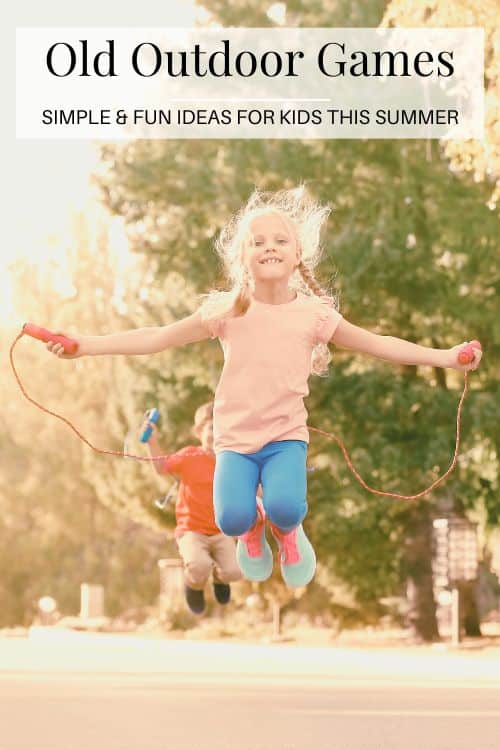
Jump Rope
Overview: Jump Rope is one of the many versatile old outdoor games that promotes physical fitness and coordination. It can be played solo or with others, with countless variations and chants.
How to Play: A single player jumps over a rope swung under their feet, aiming to keep jumping without tripping. With two players, one swings the rope while the other jumps, or both hold ends and jump together. Chants like “Cinderella, dressed in yella” add a musical element. Variations include double Dutch (two ropes) or group games where players jump in and out.
Historical Context: Jump Rope dates back to ancient Egypt and China, where it was used for exercise and play. It became a schoolyard staple in the 20th century.
Tips for Parents: Start with a lightweight rope and practice basic jumps. Teach simple chants to keep kids motivated. For groups, try games like “Helicopter,” where one player spins the rope low for others to jump over.
Why Kids Love It: The rhythmic motion and potential for tricks (like crossovers) make it endlessly engaging.
Thumb War
Overview: Thumb War is a quick, playful game that pits two thumbs against each other in a battle of strength and strategy.
How to Play: Two players face each other, clasping hands with thumbs up. They chant, “One, two, three, four, I declare a thumb war!” and attempt to pin the opponent’s thumb for three seconds. The first to pin wins.
Historical Context: Thumb War’s origins are unclear, but it’s a universal game, often played spontaneously in classrooms or waiting lines.
Tips for Parents: Teach kids to use strategy, like faking a move to catch the opponent off guard. It’s a great game for hot days, as it requires minimal movement.
Why Kids Love It: The simplicity and competitive nature make it a fun, low-effort game for any moment.
Bridge Ball
Overview: Bridge Ball is a lively old outdoor game that combines aiming and dodging, perfect for small groups or pairs.
How to Play: Players stand in a circle with legs spread, forming “bridges.” One player bounces a ball to pass through another player’s legs, aiming to “knock them out.” If the ball goes through your legs, you’re out. The last player standing wins.
Historical Context: Bridge Ball is a modern twist on traditional ball games, often played in schoolyards or camps.
Tips for Parents: Use a soft ball to avoid injuries. For two players, take turns bouncing the ball at each other’s legs. Play on grass for safety.
Why Kids Love It: The mix of aiming and dodging creates fast-paced fun with minimal rules.
Simon Says
Overview: Simon Says is a classic old outdoor game of listening and quick thinking, playable anywhere.
How to Play: One player is “Simon” and gives commands, such as “Simon says touch your nose.” Players must follow only commands preceded by “Simon says.” If a player follows a command without “Simon says” (e.g., “Touch your nose”), they’re out. The last player remaining wins.
Historical Context: Simon Says has roots in 19th-century parlor games, designed to test attention and obedience.
Tips for Parents: Start with simple commands for younger kids. Use silly actions to keep it fun. It’s great for indoor play or waiting rooms.
Why Kids Love It: The challenge of staying alert and the humor of mistakes make it a hit.

Tug of War
Overview: In this old outdoor game you’ll test both strength and teamwork, playable with as few as two players.
How to Play: Two players or teams pull on opposite ends of a rope, aiming to drag the other side across a designated line. The first to pull their opponent over wins.
Historical Context: Tug of War dates back to ancient civilizations, including Egypt and China, and was once an Olympic sport.
Tips for Parents: Use a sturdy rope and play on grass to prevent injuries. For two players, mark a center line to make it fair.
Why Kids Love It: The physical challenge and competitive spirit make it exhilarating.
Hide & Seek
Overview: Hide & Seek is a universal favorite old outdoor game that combines strategy, stealth, and excitement.
How to Play: One player is the seeker, counting to a set number (e.g., 20) while others hide. The seeker shouts, “Ready or not, here I come!” and searches for the hiders. The first found becomes the next seeker, or the game continues until all are found.
Historical Context: Hide & Seek has been played for centuries, with variations across cultures, often used to teach counting and observation.
Tips for Parents: Set boundaries to keep kids safe. For younger kids, count to a smaller number. Try indoor versions on rainy days.
Why Kids Love It: The thrill of hiding and the anticipation of being found create endless excitement.
More Than 2 Player Old Outdoor Games

What’s the Time Mr. Fox?
Overview: This old outdoor game blends suspense and speed, with a playful narrative that captivates kids.
How to Play: One player is “Mr. Fox,” standing at a distance from the others, who line up and ask, “What’s the time, Mr. Fox?” Mr. Fox responds with a time (e.g., “3 o’clock”), and players take that number of steps forward. At any point, Mr. Fox can say, “Dinner time!” and chase the players back to the starting line. Anyone caught becomes the next Mr. Fox or joins Fox’s team.
Historical Context: This game likely evolved from storytelling traditions, with roots in European folklore.
Tips for Parents: Ensure a safe running area. For younger kids, shorten the distance. Add variations like “What’s the time, Mr. Wolf?”
Why Kids Love It: The suspense of waiting for “Dinner time!” and the chase create a thrilling experience.
Red Rover
Overview: Red Rover is a high-energy team old outdoor game that tests strength and strategy.
How to Play: Two teams line up facing each other, holding hands. One team chants, “Red Rover, Red Rover, send [name] right over!” The named player from the opposing team runs to break through the linked hands. If they break through, they return to their team and take an opponent with them. If they fail, they join the other team. The game continues until one team is depleted.
Historical Context: Red Rover dates back to 19th-century Britain, often played in schoolyards.
Tips for Parents: Supervise to prevent rough play. Ensure kids hold hands gently to avoid injuries. Play on soft ground.
Why Kids Love It: The competitive team dynamic and physical challenge make it a crowd-pleaser.
Kick the Can
Overview: Kick the Can combines elements of hide-and-seek and tag, with a unique twist.
How to Play: Place a can in an open area. One player is “It,” guarding the can, while others hide. Hiders try to sneak back and kick the can without being tagged. If tagged, they go to “jail.” If someone kicks the can, all jailed players are freed. The game continues until all hiders are caught or the can is kicked.
Historical Context: Kick the Can emerged in the early 20th century, popular in urban neighborhoods where cans were plentiful. Seriously, they played with anything back then!
Tips for Parents: Use a plastic bottle for safety. Set clear boundaries for hiding. Supervise to ensure fair play.
Why Kids Love It: The mix of stealth, strategy, and the chance to free friends is irresistible.

Duck, Duck, Goose
Overview: Duck, Duck, Goose is a circle game of anticipation and speed, perfect for young kids.
How to Play: Players sit in a circle. One player walks around, tapping heads and saying “Duck” until they choose a “Goose.” The Goose chases the tapper around the circle, trying to tag them before they sit in the Goose’s spot. If tagged, the tapper goes again; if not, the Goose becomes the tapper.
Historical Context: This game has roots in European circle games, with variations like “Drop the Handkerchief.”
Tips for Parents: Ensure a safe running area. For younger kids, keep the circle small. Add silly variations, like saying “Frog” instead of “Duck.” And most importantly if you have a variety of ages be sure to monitor that everyone is being included.
Why Kids Love It: The surprise of being chosen and the chase create bursts of excitement.
Capture the Flag
Overview: Capture the Flag is an epic team game that combines strategy, stealth, and speed.
How to Play: Divide players into two teams, each with a flag (or object) placed in their territory. The goal is to capture the opposing team’s flag and return it to your base without being tagged. If tagged in enemy territory, you go to “jail” until a teammate frees you. The first team to capture the flag wins.
Historical Context: Capture the Flag likely originated in military training exercises, adapted for play in the 20th century.
Tips for Parents: Use bright objects as flags and set clear boundaries. Supervise to prevent rough play. Try indoor versions with pillows as flags.
Why Kids Love It: The mix of teamwork, strategy, and adventure feels like a real mission.
Flashlight Tag and Other Variations of Tag
Overview: Flashlight Tag is a nighttime twist on tag, combining hide-and-seek with a unique tagging method. Other tag variations include Freeze Tag, Sharks and Minnows, and Chain Tag.
How to Play (Flashlight Tag): One player is “It,” using a flashlight to tag others by shining the beam on them. Players hide in a dark area, and the first tagged becomes the next “It.” For Freeze Tag, tagged players freeze until unfrozen by a teammate. Sharks and Minnows involves “sharks” tagging “minnows” in a designated area.
Historical Context: Tag games are ancient, with variations across cultures. Flashlight Tag emerged with the availability of portable flashlights in the 20th century.
Tips for Parents: Ensure a safe, obstacle-free area for Flashlight Tag. Use low-power flashlights to avoid blinding. Teach multiple tag variations to keep things fresh.
Why Kids Love It: The nighttime setting and flashlight beam would add a thrilling, adventurous vibe to any old outdoor games!

Tips for Introducing These Old Outdoor Games
- Start Simple: Begin with old outdoor games like Simon Says or Thumb War, which have few rules and no equipment.
- Demonstrate First: Show kids how to play, especially for games like Jacks or Hopscotch, which may be unfamiliar.
- Encourage Creativity: Let kids modify rules or invent new variations to keep things fresh.
- Mix Group Sizes: Alternate between two-player and group games to suit different occasions.
- Make It a Tradition: Set aside a weekly “game night” to try new games or revisit favorites.
- Involve Everyone: Encourage parents, siblings, and neighbors to join, making it a community event.
Indoor Adaptations of Old Outdoor Games
- Jacks and Pick Up Sticks: Play on a smooth floor or table.
- Simon Says and Thumb War: Require minimal space and no equipment.
- Hide & Seek: Use a smaller area, like a single room, with creative hiding spots.
- Bridge Ball: Use a soft ball and play in a hallway.
- Handclap Games: Perfect for any indoor setting.
Old Outdoor Games
Overall, physically active and mentally stimulating old outdoor games are an amazing way to build bonds and connect with friends and family. In short, instead of sitting around and playing video games all summer, let’s go outside and play together.
These old outdoor games are just waiting to be played again for all to enjoy. So gather your family together and try these old outdoor games with your kiddo. You may just find them teaching their friends next time they go to a park or when at a family gathering. Which one’s will you try? Let me know in the comments. What’s the time Mr. Fox? Is the first one I want to go play with my sons.
Recent Posts on the Homeschool Blog