
TRAINS FOR KIDS
Your child will love these train activities.
— By Julie Hodos on December 15, 2024; Updated on December 30, 2025.
This post may contain affiliate links. Please refer to our disclosure policy.
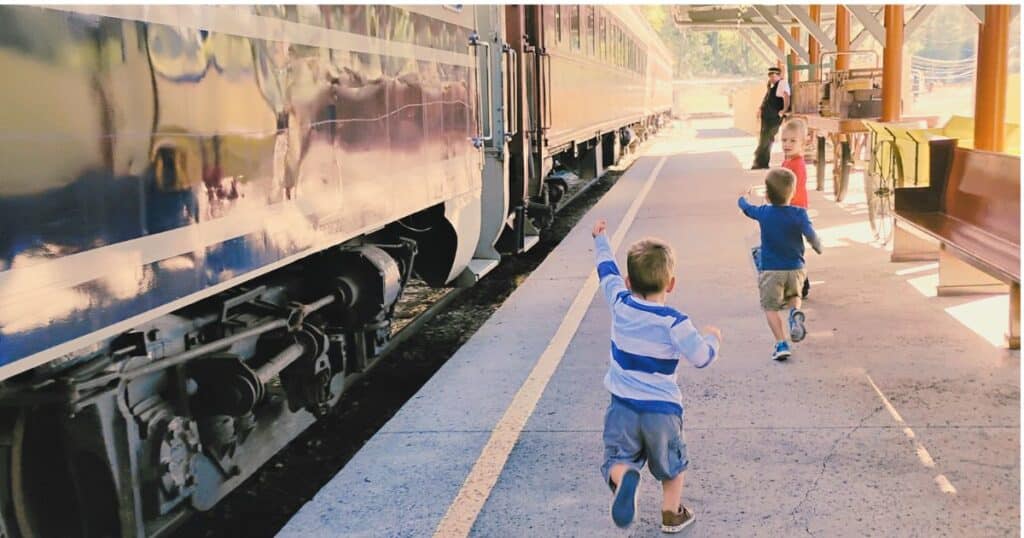
Does the word “train” illicit pure magical awe in your child. Spotting a train running on the rails while driving, flipping through a picture book featuring trains or playing with toy train cars and tracks turns any ordinary day into an adventure full of whistles, clicks, and endless imagination.
All aboard — let’s keep those little engineers wondering, imagining, and busy for hours!
Table of Contents
Why Trains Are a Great Homeschool Topic
Beyond imagination and wonder, trains have the potential to check every single box we homeschool parents dream about:
- STEM goldmine: physics, engineering, geometry, measurement, magnetism, fractions… it’s all there.
- History & geography built in: routes, famous trains, industrial revolution, mapping skills.
- Fine motor + gross motor: building tracks, pushing trains, hauling “cargo.”
- Language arts: storytelling, sequencing, writing train tickets or cargo manifests.
- Social-emotional: cooperative play, turn-taking, problem-solving when tracks collapse (because they always do).
- Works for mixed ages—big kids can dive more into details of mechanics, history, and build elaborate layouts while toddlers zoom cars around the outside.
Train Activities for Toddlers (Ages 1–3)
- Cardboard Box Train Stack three or four cardboard boxes, cut an opening in each, and link them with yarn or just line them up on the floor. Add paper-plate wheels and a construction-paper smokestack, then let your toddler climb in and “drive” while you push or pull. They’ll happily haul stuffed animals, blankets, or snacks from room to room all afternoon. Learning Opportunity: Gross motor development, spatial awareness, and early pretend play that builds narrative skills.
- Painter’s Tape Track on the Floor Lay down giant loops of painter’s tape across the living room or hallway to create roads and tracks. Toddlers can push trains, cars, or even crawl the route themselves while you call out stops like “Kitchen Station” or “Teddy Bear Junction.” When they’re done, the tape peels right up with zero mess. Learning Opportunity: Directionality (over, under, around), following verbal instructions, and body awareness.
- Edible Train Snack Let your child build a train on their plate using graham crackers for cars, pretzel sticks for connectors, Cheerios for wheels, and a marshmallow smokestack. They get to decorate with icing “glue” first, then eat their creation. Learning Opportunity: Fine motor skills, sequencing (first this car, then that car), and healthy excitement about food.
- Living Room Song & Movement Train Everyone lines up holding shoulders while you lead as the engine, chugging and whistling to “Down by the Station” or “I’ve Been Working on the Railroad.” Stop at imaginary stations to pick up passengers or cargo. Learning Opportunity: Rhythm, listening skills, balance, and cooperative play.
- Pom-Pom Train Pull Tie several small baskets or boxes together with ribbon and fill them with pom-poms or cotton balls as “coal.” Little ones pull their train around, stopping to reload when cargo spills (which it always does). The spills actually make it more fun. Learning Opportunity: Cause and effect, persistence, and early physics (weight affects pulling effort).

Train Activities for Preschoolers (Ages 3–5)
- Mega Mixed-Media Track Build Dump out wooden tracks, Duplo, Magna-Tiles, blocks, and even couch cushions, then challenge them to build the biggest layout they’ve ever made. Add tape “rivers” they must bridge and books for tunnels. They will work on this for hours and beg to leave it up overnight. Learning Opportunity: Problem-solving, engineering basics, perseverance through trial and error.
- Conductor Ticket Station Cut cardstock tickets, set up two rows of chairs as the train, and take turns being the conductor who punches tickets with a hole punch. Add a cash register or basket for dramatic flair. Learning Opportunity: Role-playing real-world jobs, turn-taking, number recognition on tickets.
- Color & Size Cargo Sorting Fill muffin tins with different “cargo” (pom-poms, beans, beads) in various colors and sizes. Kids must load only red cargo onto the red train, big blocks onto the freight cars, etc. Sneaky sorting practice that feels like pure play. Learning Opportunity: Classification, comparing attributes, early math foundations.
- Train Track Process Art Painting Lay wooden or plastic tracks on butcher paper, dip toy trains in washable paint, and let them drive through to make colorful tracks. The patterns appear fun and interesting, and they’ll want to make ten paintings in a row. Hang them up to dry and use as wrapping paper later. Learning Opportunity: Cause and effect, color mixing, creativity without perfection pressure.
- Indoor Train Obstacle Course Use pool noodles as tunnels, chairs as stations, pillows as mountains, and hula hoops as “lakes.” Time them with a stopwatch or just let them repeat until they collapse giggling. Works off energy on rainy days beautifully. Learning Opportunity: Gross motor planning, sequencing steps, body coordination.
- Number Line Hopping Train Make a masking-tape number line 1–20 on the floor. Each train car gets a number; kids drive their train to the number you call out or add/subtract simple problems (“Drive to 5, now go back 2”). Learning Opportunity: Number recognition, counting forward/backward, early addition and subtraction.

Train Activities for Early Elementary (Ages 6–9)
- Permanent Cardboard Village Layout Save cereal boxes, toilet rolls, egg cartons for weeks, then spend a weekend building a town with hot-glued tracks (parent job). Paint it together, add signs, trees, and people. This becomes a treasured permanent playscape. Learning Opportunity: Planning, measurement, community geography, pride in long-term projects.
- Working Drawbridge Engineering Use popsicle sticks, string, and tape to build a real drawbridge that lifts for toy boats passing underneath a blue blanket river. Kids test, fail, redesign, and eventually cheer when it finally works. Pure STEM joy. Learning Opportunity: Engineering design process, levers and pulleys, problem-solving resilience.
- Magna-Tile Elevated Track System Stack Magna-Tiles to create ramps and elevated sections for wooden tracks. They will spend days perfecting the tallest, loopiest, most daring layout possible. Add cardboard tube tunnels for extra drama. Learning Opportunity: Geometry, balance, structural stability, spatial reasoning.
- Baking Soda & Vinegar Steam Engine Build a “volcano” inside a model train engine’s smoke stack using clay or playdough, then add baking soda and vinegar with droppers to make it erupt “steam.” Repeat until every drop of vinegar is gone. Learning Opportunity: Chemical reactions, scientific method (predict, test, observe), fine motor control with droppers.
- Train Track Symmetry Design Challenge them to build a track that is perfectly symmetrical or has mirror-image sides. They can use a drawn line of symmetry or just eyeball it. A fun challenge every time. Learning Opportunity: Mathematical symmetry, attention to detail, visual-spatial skills.
- Passenger Manifest Math Write a manifest: Car 1 holds 8 passengers, Car 2 holds 5, etc. Kids use toy people or beans to fill exactly, then solve story problems (“If 3 passengers get off at Station 2…”). Learning Opportunity: Addition, subtraction, word problems made tangible.
- Recycled Material Bridge Challenge Give them straws, pipe cleaners, popsicle sticks, and tape. The train must cross a 12-inch gap without falling. Multiple rounds with different materials keep it fresh. Learning Opportunity: Engineering, material science, testing hypotheses.
- Train Route Mapping Draw a giant map of your house or an imaginary country on butcher paper. Kids plan routes, measure distances with string, and calculate travel time based on speed. Learning Opportunity: Map skills, measurement, scale, basic multiplication (distance × speed).
- Mystery Cargo Logic Game Place different cargo in identical boxes. Give clues (“This car has something that rattles” or “This one is heavier than the blue one”). Kids use logic to match cargo to cars. Learning Opportunity: Deductive reasoning, comparing attributes, critical thinking.
- Train Timeline History Project Print pictures of trains from steam to bullet and have kids put them in chronological order on a long strip, adding facts they research or you read aloud. Learning Opportunity: Historical sequencing, research skills, sense of technological progress.
- Pulley-Powered Coal Loader Use string, a small basket, and a DIY pulley to load “coal” (black beans) into a freight car. Simple machines in action they can actually play with afterward. Learning Opportunity: Physics of pulleys, mechanical advantage, experimentation.
Train Activities for Upper Elementary & Tweens (Ages 9–12)
- Working Electric Lemon Battery Train Use lemons, pennies, nails, wire, and a small motor to actually power a tiny train car. Mind-blowing and totally doable with guidance. Learning Opportunity: Circuits, electricity, chemical energy → electrical energy.
- Cardboard Automata Steam Engine Build a cam-driven moving steam engine model that actually puffs a piston when you turn a crank. Templates online, but the engineering is incredible. Learning Opportunity: Mechanical engineering, cams and followers, persistence through complex builds.
- Train Schedule Timetables Create realistic train timetables with departure/arrival times across multiple cities. Kids solve problems like “If you miss the 2:15, how long until the next train?” Learning Opportunity: Time calculation, elapsed time, real-world math application.
- Scale Model City Planning Use graph paper to design a city to 1:87 scale (HO scale). Measure buildings, calculate real vs. model dimensions. Learning Opportunity: Ratios, proportions, scale drawings, urban planning.
- Stop-Motion Train Movie Use a small pad of unlined paper to create a short stop-motion movie of trains coming to life. Script, storyboard, voiceover—the works. Learning Opportunity: Storytelling, patience, digital media skills, sequencing frames.
- Freight Economics Game Assign different values to cargo types. Kids decide routes and loads to maximize profit while paying “fuel” costs. Supply/demand twists optional. Learning Opportunity: Economics basics, profit calculation, decision-making with limited resources.
- Transcontinental Railroad Research & Model Research the 1860s railroad, then build a diorama depicting what a railroad station/depot might look like during that time period. Learning Opportunity: Deep historical research, empathy for different perspectives (workers, Native nations, robber barons).

Mixed-Age & Family Train Activities
- Train Museums Explore a local (or take a family trip) train museum. We’ve visited a few with our boys and have loved the experience. Some are full of model trains with kid areas for playing or riding small engines. Others are old train depots that have been converted into a museum and offer train rides on old steam engines.
- Backyard Zip-Line Freight Delivery String a rope between two trees or playsets, attach a pulley and basket, and send cargo zooming between stations. Everyone can play at their level. Learning Opportunity: Gravity, incline, teamwork across ages.
- Train Charades Act out different types of trains (steam puffing, diesel rumbling, bullet super fast) or jobs (conductor, engineer, brakeman, passenger, etc.). Hilarious for family night. Learning Opportunity: Non-verbal communication, vocabulary building.
- Giant Floor Map Geography Train Tape a world or USA map on the floor. Kids plan routes from New York to California or Paris to Moscow, marking famous railways. Learning Opportunity: Geography, famous routes (Trans-Siberian, Orient Express), distance concepts.
Read Next: Train Crafts for Kids

Even More Train Activities (Because You Can Never Have Too Many!)
- Laundry Basket Trains Turn clean (or empty!) laundry baskets into train cars by lining them up. Kids climb in and pretend to be engineers or ticketers, and use their imaginations for hours of entertainment. Countless times you’ll hear, “All aboard!” Older siblings can be engineers while toddlers ride as passengers. Learning Opportunity: Gross motor skills, cooperative play, and understanding simple machines (pulling = work).
- Flashlight Shadow Trains At bedtime or during a rainy afternoon, turn off the lights and use a strong flashlight to cast train shadows on the wall. Move toy trains or cut-out silhouettes in front of the beam to create a moving night-time railroad show complete with whistle sound effects. Learning Opportunity: Light behavior, shadow formation, oral storytelling in low-pressure setting.
- Train Yoga Poses Create a sequence: “Mountain Tunnel” (mountain pose), “Chugging Engine” (chair pose), “Caboose” (forward fold), “Steam Release” (lion’s breath). Move through the poses as you tell a train story. Perfect calm-down activity before nap or bedtime. Learning Opportunity: Body awareness, breath control, emotional regulation through movement.
- DIY Train Whistle Crafts Use empty toilet paper tubes, wax paper, and rubber bands to make real working train whistles (just hum into them). Decorate with markers and stickers, then have a whistle concert as the train pulls out of the station. Learning Opportunity: Sound vibration science, fine motor practice, following multi-step directions.
- Train Tangram Designs Print or draw train outlines and let kids fill them with pattern blocks to create colorful engines and cars. Or free-build symmetrical trains. The designs get surprisingly intricate once they get going. Learning Opportunity: Geometry, spatial reasoning, symmetry, tessellation concepts.
- Recycled K-Cup Coal Tenders Save those little coffee pods, paint them black, and attach behind toy engines as coal cars. Fill with black beans or pom-poms for authentic loading/unloading play. Learning Opportunity: Recycling awareness, imaginative extension of existing toys, fine motor pouring.
- Train Song Parodies Take familiar tunes (“Wheels on the Bus”) and rewrite them: “The engine on the train goes chug chug chug…” Kids invent new verses about cargo, passengers, or destinations. Record the final masterpiece on your phone. Learning Opportunity: Phonological awareness, rhyming, creative language play.
- Sidewalk Chalk Track Mazes Draw enormous, sprawling train tracks outside with branches, loops, dead-ends, and multiple stations. Kids ride bikes, scooters, or just run the route delivering “mail.” Rain washes it away for a fresh canvas tomorrow. Learning Opportunity: Large-scale mapping, direction following, outdoor gross motor planning.
- Train Ticket Sight-Word Punch Cards Write sight words on cardstock tickets. Every time a child reads one correctly, they get to punch a hole with the conductor punch. Ten punches = prize (extra story, dessert, etc.). Learning Opportunity: Sight word fluency, delayed gratification, real-world reward systems.
- Pool Noodle Tunnel Races Cut pool noodles in half lengthwise to make instant train tunnels. Line them up and race cars, balls, or even pom-poms blown with straws through the system. Add obstacles for complexity. Learning Opportunity: Physics of motion, incline, air pressure, trial-and-error experimentation.
- Train-Themed Mad Libs Create simple Mad Libs: “The _____ train carried _____ (adjective) (plural noun) to _____ (place).” Kids supply words without knowing the story, then read the hilarious results together. Learning Opportunity: Parts of speech, laughter-induced language love.
- Cardboard Marble Run “Freight Chutes” Tape toilet paper tubes and cardboard pieces to the wall or a slanted board to create freight-loading chutes. Drop marbles or pom-poms as cargo into waiting train cars below. Learning Opportunity: Gravity, angles, momentum, engineering design process.
- Train Station Dramatic Play Store Set up a full station with a ticket counter (old keyboard as cash register), waiting benches, suitcase props, and destination signs. Kids sell tickets, announce arrivals, check luggage—hours of rich pretend play. Set this up with laundry baskets and any other imaginative play scenario we’ve already mentioned. Learning Opportunity: Social skills, money concepts, real-world role playing.
- LEGO Train Challenges Give specific challenges: tallest bridge that holds weight, longest train that fits on the table, fastest loop-de-loop. Document with photos for a family “Train Engineering Hall of Fame.” Learning Opportunity: Structural engineering, measurement, perseverance through failure.
- Train Book Bingo Make bingo cards with train book titles or elements (red caboose, steam engine, crossing sign). Read train books together and mark spaces as they appear. First to bingo picks the next book. Learning Opportunity: Reading comprehension873, attention to detail, motivation to read more.
- Homemade Playdough Tracks & Stamps Make gray or black playdough for tracks, then use toy trains to press authentic track prints. Add LEGO wheels or bottle caps for different patterns. Learning Opportunity: Sensory integration, texture exploration of positive/negative space, creative expression.

Must-Read Train Books That Will Fuel Even More Play
These are the train books my kids (and I) have read until the covers fell off. They’re perfect for read-alouds, quiet time, or inspiration for new train activities.
- The Little Engine That Could by Watty Piper (ages 2–7) – The classic and ultimate growth-mindset story. We quote “I think I can” during every tough track build.
- Freight Train by Donald Crews (ages 1–5) – I love the simple and bold colors that help differentiate each train car from another. Perfect for color and vocabulary building of different car names. This train book earned the Caldecott Honor.
- The Goodnight Train by June Sobel (ages 2–6) – This dreamy, rhyming journey will lull your child to sleep dreaming all about trains.
- Steam Train, Dream Train by Sherri Duskey Rinker (ages 3–7) – The gorgeous illustrations depicting animals loading cargo at night is pure magic.
- Locomotive by Brian Floca (ages 5–10) – This train book is a stunning Caldecott winner about the 1869 transcontinental journey. With rich historical details you don’t want to miss this one.
- The Polar Express by Chris Van Allsburg (ages 4+) – A Christmas classic, but we read it year-round because believing is everything.
- Trains Go by Steve Light (ages 1–4) – The giant format with incredible sound words absolutely captivates my toddler.
- The Train to Impossible Places by P.G. Bell (ages 8–12) – A great chapter book fantasy adventure on a magical troll train. First in a series.
- How to Train a Train by Jason Carter Eaton (ages 4–8) – This is a tongue-in-cheek guide to catching and caring for your own pet train.
- The Big Book of Train by DK (ages 4-12) – This train book depicts real trains. My little ones love simply flipping through the pages and looking at the beautiful, interesting trains while my eldest can read the plethora of information offered.

Keep the Trains Rolling All Year Long!
Check out our best selling train resource for preschoolers learning the alphabet. It’s great for introducing letters with tracing and review with games: Train Wall Display.
You now have more than enough train activities and train books to last until your kids outgrow the obsession (or, let’s be honest—until they’re teenagers and suddenly it’s “lame,” but secretly still love it). Save this post, pin it, share it with friends—whatever you need to do. Leave a comment below sharing which activity or activities you’re most excited to try. Your kids are going to be happily chugging along while quietly mastering STEM, literacy, history, geography, emotional regulation, and every life skill we parents secretly hope for.
Happy playing for hours, friends! May your tracks always be clear and your coffee always strong.
Recent Posts on the Blog