MOON PHASES
4 phases of the moon during snack time.
— By Julie Hodos on September 6, 2024; Updated on October 11, 2025.

This post may contain affiliate links. Please refer to our disclosure policy.
Does your kiddo love cookies? If so, why not turn snack time into a magical learning adventure about our vast universe? Imagine your child munching on delicious treats while discovering the wonders of the moon’s changing appearances. This hands-on activity uses simple cookies and a free printable to teach the phases of the moon in a way that’s engaging, memorable, and perfectly suited for young minds. Whether you have a curious preschooler, a kindergarten explorer, or older child ready for more details, this lesson can be tailored to fit their age and interest level.
Table of Contents

Here, we’ll dive deep into the moon’s mysteries, starting with the basics and building up to more advanced concepts. While the moon goes through eight distinct phases in its monthly cycle, many educators simplify it by highlighting the 4 phases of the moon—new moon, first quarter, full moon, and third quarter—as key milestones. These 4 phases of the moon serve as anchors, making it easier for young children to grasp the overall pattern before exploring the in-between stages like crescents and gibbous moons and whether they are waxing or waning. By the end, you’ll have everything you need to create a stellar learning experience right at home.
Why Teach Children About the Moon?
The moon is one of the first celestial objects kids notice in the night sky—it’s big, bright, and ever-changing, which naturally piques their curiosity. Teaching about the moon helps foster a sense of wonder about the world beyond our planet, encouraging scientific thinking from an early age.
For preschoolers (ages 3-4), learning about the moon builds observation skills and introduces basic concepts like light and shadow. It’s a gentle way to spark interest in science without overwhelming them. Kindergarteners (age 5) start to connect the moon’s changes to patterns and cycles, which ties into early math concepts like sequencing and time. By first grade (ages 6-7), children can delve into cause-and-effect relationships, such as how the moon’s position relative to the Earth and sun affects what we see. This not only enhances their understanding of astronomy but also boosts vocabulary, critical thinking, and even emotional development—think about how stories of the moon can inspire imagination and reduce fear of the dark.
Beyond academics, moon lessons promote family bonding. Observing the night sky together creates shared memories and encourages outdoor time. In a world full of screens, this topic reconnects kids with nature’s rhythms, teaching patience as they wait for the moon to change over days or weeks. Plus, it’s inclusive: no fancy equipment needed, just eyes, books, and everyday items like cookies. By tailoring the depth—simple visuals for preschoolers, names and explanations for older kids—you ensure every child feels successful and excited to learn more.
Research shows that early exposure to STEM topics like astronomy can ignite lifelong interests. Children who learn about the moon often ask deeper questions about space, leading to explorations of planets, stars, and even gravity. It’s practical too: understanding moon phases can tie into real-life events like holidays or wildlife behaviors. Ultimately, teaching about the moon empowers kids to see themselves as part of a bigger universe, building confidence and curiosity that lasts a lifetime.

Books About the Moon
Books are a fantastic way to frontload knowledge before hands-on activities. They make abstract concepts tangible through illustrations and narratives, helping children visualize the moon’s transformations. Start with read-aloud sessions over a few days, pointing out pictures of the moon in different shapes to build familiarity and excitement. Below is a curated list of books, each with a description and the age group it’s best suited for. Read in a cozy spot, perhaps under a blanket fort or even outside under the stars. Be sure to revisit books after the activity to reinforce learning.
- Harold and the Purple Crayon by Crockett Johnson
This whimsical classic follows Harold as he draws his own world with a magical purple crayon, including a glowing moon that lights his way. The simple storyline and imaginative tone make the moon feel like a friendly companion in the night sky. After reading, encourage kids to draw their own moonlit adventures, connecting creativity to observation.
Suitable for: Preschool (ages 3-4) - I See the Moon by Jacqueline Mitton
This charming book features animals gazing at the moon as it changes shapes, told through gentle rhymes and vibrant illustrations. It introduces the idea of moon phases without technical terms, perfect for young learners who love animals. Discuss how the moon “hides” or “grows” like in the story to spark curiosity.
Suitable for: Preschool (ages 3-4) - The Moon Book by Gail Gibbons
Gail Gibbons delivers a clear, illustrated guide to the moon’s phases, movements, and characteristics. With straightforward explanations and detailed diagrams, it’s a great mix of facts and visuals. Pause during reading to mimic moon shapes with hands or compare to the cookie activity for a hands-on connection.
Suitable for: Kindergarten (age 5) & First Grade (ages 6-7) - The Moon Seems to Change by Franklyn M. Branley
Part of the Let’s-Read-and-Find-Out Science series, this book explains moon phases with simple text and experiments, like using a ball and flashlight to show light and shadow. It’s engaging yet educational, perfect for kids ready to explore causes. Compare book diagrams to cookies during the activity for reinforcement.
Suitable for: First Grade (ages 6-7) - Moon: Earth’s Best Friend by Stacy McAnulty
In this playful book, the moon narrates its own story as Earth’s loyal companion, sharing facts about phases and orbits with humor and personality. The personification makes science feel like a story, keeping kids engaged. Use it to review phases or inspire kids to write a letter from the moon.
Suitable for: First Grade (ages 6-7)
When reading, adapt based on age: For preschoolers, focus on pictures and basic ideas like big moon versus small moon. Kindergarteners can name the 4 phases of the moon from illustrations. First-graders might journal what they learned or predict the next phase. Repetition and discussion make these stories a powerful lead-in to the cookie activity.
Understanding the Moon Phases
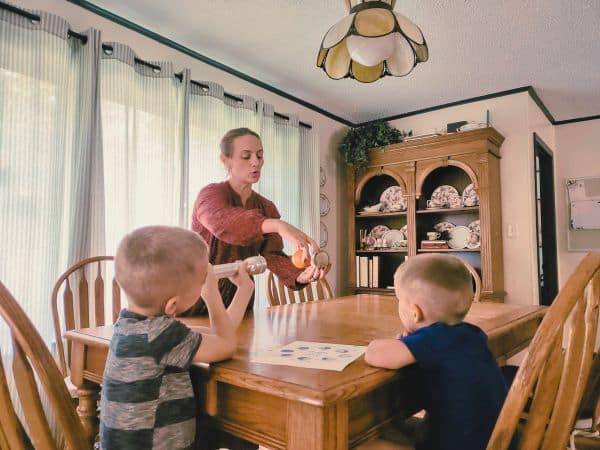
Now, let’s break down the science in a way that’s easy to share with your child. Remember, the moon doesn’t produce its own light; it’s like a giant mirror reflecting sunlight. As it orbits Earth, the amount of lit surface we see changes, creating phases. While there are eight phases in total, we’ll emphasize the 4 phases of the moon as starting points: new moon (invisible), first quarter (half-lit, growing), full moon (fully lit), and third quarter (half-lit, shrinking). This simplification helps younger kids without losing the big picture.
Start with why phases happen: The moon circles Earth every 29.5 days, and its position relative to the sun determines what’s visible. Demonstrate reflection with a flashlight and mirror in a dark room—shine the light on the mirror and show how only part might be seen from certain angles. For preschoolers, say, “The moon plays hide-and-seek with the sun’s light!” Kindergarteners can add, “It gets brighter as it moves.” First-graders might discuss orbits: “The moon is like a ball spinning around us.”
Dive into key contrasts. A full moon is when the whole Earth-facing side is sunlit, appearing as a bright circle. It’s often the most exciting—mention fun names like Wolf Moon (January) or Harvest Moon (September) to tie into seasons. Explain origins practically: Harvest Moon helped farmers work late with extra light. A new moon is opposite—the moon is between Earth and sun, so no light reaches us, making it “disappear.” Use this to teach cycles: “It starts dark and grows again.”
The first quarter and third quarter are midway points. In the first quarter (waxing phase), a quarter of the moon’s total surface is lit, but it looks half-full to us. It’s between new and full. The third quarter (waning) is similar but between full and new, with light decreasing. To remember: Waxing means “growing” like adding wax to shine something; waning means “shrinking” like dwindling away.
Then, introduce in-betweens: Crescents are slim slivers near new moon (waxing crescent growing, waning crescent shrinking). Gibbous moons are mostly full but not quite (waxing gibbous approaching full, waning gibbous after). For tailoring: Preschoolers focus on “skinny moon” (crescent) vs. “fat moon” (gibbous). Kindergarteners learn names with rhymes like “Crescent is curved like a smile.” First-graders can sequence all eight and explain differences.
Keep discussions short and interactive—use gestures or props. Over time, this builds a solid foundation, turning abstract science into something tangible and fun.

Fun Facts About the Moon
To make your moon lesson even more exciting, sprinkle in these fun facts during the cookie activity or storytime. Tailor delivery for age—short and playful for preschoolers, with more detail for kindergarteners and first-graders. These facts connect to the 4 phases of the moon and beyond, igniting curiosity.
- The Moon Has No Light of Its Own: The moon shines because it reflects sunlight, like a mirror in the sky. For all ages I will bring out a mirror and flashlight to demonstrate reflection of light.
- It’s Earth’s Only Natural Moon: Unlike some planets with many moons, Earth has just one. Call it “Earth’s best buddy” for young kids; first-graders can compare it to Jupiter’s 95 moons.
- It’s Covered in Craters: The moon’s surface has holes from space rocks hitting it. Show preschoolers a picture (or describe one); first-graders can draw craters and learn they’re from no atmosphere protecting it. Here is a great activity to demonstrate craters forming from Science Buddies.
- The Moon Is Drifting Away: Each year, the moon moves about 1.5 inches farther from Earth. For kindergarteners, say, “It’s taking tiny steps away!” First-graders can discuss gravity’s role.
- It Has a Dark Side: The moon’s far side, which we never see, isn’t really “dark”—it gets sunlight too. Preschoolers love the mystery; older kids learn it’s due to tidal locking.
- Full Moons Have Special Names: Each month’s full moon has a name, like Wolf Moon or Strawberry Moon, tied to nature or history. Let kids pick a favorite name and imagine why it’s called that.
- It’s Dusty Up There: Moon soil, called regolith, is like powdery sand. Tell preschoolers, “It’s like a dusty playground!” First-graders can compare it to Earth’s soil.
- The Moon Affects Animals: Some animals, like corals, time their behaviors to moon phases. Share with kindergarteners, “Turtles lay eggs under moonlight!” Older kids can dig deeper.
- People Walked on the Moon: In 1969, astronauts like Neil Armstrong landed on the moon. For first-graders have them learn about space ships, living conditions, famous people, and name Apollo missions.
- The Moon Has No Air: There’s no atmosphere, so no wind or sound. Tell preschoolers, “It’s super quiet up there!” First-graders can discuss why astronauts need spacesuits.

Cookie Options: Choosing the Perfect Treat for Your Moon Lesson
The star of this activity? Cookies! They represent the moon’s round shape, and nibbling them mimics phase changes. But not all cookies are equal—consider your child’s age, mess level, and dietary needs. Here are practical options:
Oreos are a top choice for their dark color (like space) and cream filling that can represent the lit part. Twist them open for easier “phases,” but they’re firm, so nibbling might create crumbs—great for fine motor practice but prepare a bowl for extras. They’re store-bought, so quick and consistent in size (about 2 inches, matching the printable).
Soft chocolate chip cookies, homemade or store-bought, are forgiving for little teeth. If homemade, keep them small—aim for 2-3 inches diameter to avoid overwhelming snacks. Soft texture means clean nibbles, no “mistake” cookies, but kids might eat them fast—bake extras!
Hard chocolate chip cookies (like crisp store varieties) challenge nibbling, promoting patience. They’re less sugary per bite, balancing snack time. If homemade, add more flour or bake longer for crunch.
I have tried this activity with homemade cookies and store bought. The store bought were crunchy chocolate chip and even though there were mistake cookies I was able to store these in a plastic baggie to have with milk another day. The homemade cookies, pumpkin chocolate chip, were definitely more filling, even though I made them small. As for the Oreos, these are a great option because they aren’t going to fill your child up and there are hardly any mistake cookies since the soft cream is what is being eaten. Overall, the activity was a hit each time and I don’t have a preference. Each choice has it’s own challenges and positives.
The Moon Phases Cookie Activity
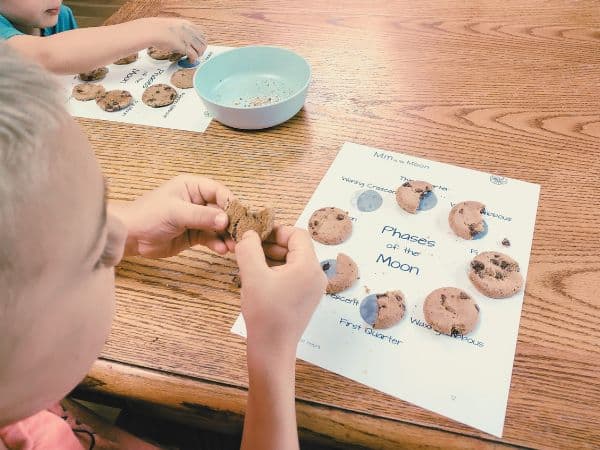
Ready for the main event? This activity uses cookies to visually represent phases, turning eating into education. You’ll need cookies (see options above), the free printable with moon diagrams, and a plate.
Tailoring for Ages
For preschoolers, simplify to the 4 phases of the moon, focusing on big/small changes without names. Use phrases like “Eat a little to make it skinny!” Expect short attention—10-15 minutes. Kindergarteners add all eight phases with basic names, encouraging repetition. Make it 20 minutes with questions like “Is it growing or shrinking?” First-graders go deeper: Name phases, explain why (for example, “Waxing means more light!”), and sequence independently. Extend to 30 minutes with discussions on how the earth’s shadow causes the moon to change.
Step 1: Prep and Discuss. Place a whole cookie on each printable phase spot. Start with basics: “The moon changes shape because of sunlight. Let’s make our cookies match!” For younger kids, demo one; older ones try alone.
Step 2: New and Full Moons. On new moon, eat the whole cookie—”It’s all dark!” Full moon: Leave it whole—”All lit up!” Discuss brightness and names.
Step 3: Quarters. First quarter: Nibble half away to show growing light. Third quarter: Same, but shrinking. Relate to the 4 phases of the moon as “halfway points.”
Step 4: Crescents and Gibbous. Waxing crescent: Nibble most away for a sliver. Waxing gibbous: Nibble a bit for almost full. Repeat on waning side. Mention waxing/waning as you go.
Step 5: Review and Eat. Go through names, have child repeat. Then, enjoy remnants! Clean up crumbs for a tidy end.
This visual, tasty method cements concepts—kids literally digest the lesson.
Read Next: Moon Phases Discussion

Free Moon Phases Printable
The free printable is a key tool in this activity, designed to make learning about the moon’s phases visual and interactive. This single-sheet resource features all eight phases of the moon arranged in a cyclical format, clearly showing the progression from new moon to full moon and back again. Each phase is depicted with a diagram that highlights the lit portion of the moon, making it easy for children to match their cookies to the corresponding shapes. The 4 phases of the moon (new moon, first quarter, full moon, third quarter) are prominent, serving as anchor points, while the crescent and gibbous phases fill in the cycle for a complete picture.
To use the printable effectively, place it on a flat surface like a table or tray where your child can easily see it. Ensure the cookies you’ve chosen (Oreos, soft chocolate chip, or hard chocolate chip) are similar in size to the moon diagrams—about 2-3 inches in diameter—for accurate matching. Lay a whole cookie on each phase diagram to start. As you guide your child through the activity, point to each phase on the printable and explain its name and appearance. The cyclical layout reinforces the repeating nature of the moon’s phases, helping kids visualize the 29.5-day cycle.
For preschoolers, focus on the 4 phases of the moon and use simple terms like “no moon” (new), “half moon” (first/third quarter), and “whole moon” (full). Point to the printable and have them nibble cookies to match these shapes, emphasizing big versus small changes. Kindergarteners can work with all eight phases, using the printable to identify names like “waxing gibbous” while nibbling. Encourage them to follow the cycle’s order on the sheet. First-graders can use the printable as a guide to sequence phases independently and discuss why each shape appears.
The printable’s clear, circular design also makes it a great reference for review. After nibbling, have kids point to each phase and say its name, using the visual as a memory aid. For added fun, keep the printable handy during nighttime moon observations to compare real skies to the diagram. Its simplicity ensures accessibility for all ages, while the cyclical format ties directly to the cookie activity, making abstract astronomy concrete and delicious. Get it below!
Extending the Learning
To reinforce moon phases, try these add-ons with descriptions. Each builds on the cookie activity, tailored for ages.
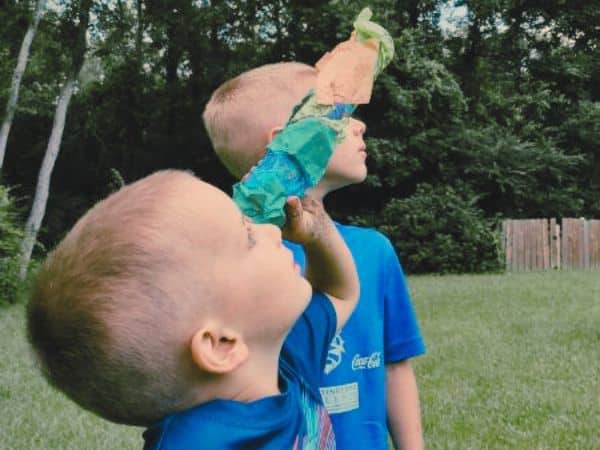
- Craft Telescope: Make a simple viewer from a paper towel tube, decorated with tissue paper. Ages 4-7 will love to use it to spot the moon around the house.
- Moon Observation Journal: Over a month, draw nightly moons. Preschoolers color shapes; kindergarteners label 4 phases of the moon; first-graders add dates and predictions. Use apps (on your phone) for tracking—check after dinner walks.
- Flashlight Demonstration: In a dark room, use a ball (moon), flashlight (sun), and child (Earth) to show phases. Preschoolers watch; older kids rotate the ball, explaining reflections.
Read Next: Moon Activities for Kids
A Universe of Possibilities
With this cookie-based lesson, you’ve given your child a delicious introduction to the moon’s phases. From books to hands-on nibbling, fun facts, and the free printable, it’s practical, adaptable, and full of joy. Watch their eyes light up as they connect snacks to stars—proof that learning can be as sweet as it is enlightening. Keep observing, keep questioning, and who knows? Your little astronomer might just reach for the moon!
Recent Posts on the Homeschool Blog