SOMEWHERE OVER THE RAINBOW
20+ Rainbow activities for kids in homeschool.
— By Julie Hodos on November 17, 2024; Updated on December 29, 2025.

This post may contain affiliate links. Please refer to our disclosure policy.
Rainbows are pure magic to kids — that moment they spot one after a storm is priceless — but they’re also one of the easiest ways to sneak in serious science, art, math, fine motor practice, and even emotional regulation, all while everyone is having way too much fun to notice they’re “doing school.” Whether you have a curious preschooler, a hands-on kindergartner, or an older kid who loves experiments, these 20+ rainbow activities will keep you in fresh ideas for weeks. Most use things you already have at home, and every single one is low-prep, high-wow. Let’s make some rainbows!
Table of Contents

Why Teaching Kids About Rainbows Is Always Worth It
Rainbows hit the sweet spot of wonder plus real science. Spotting a rainbow in the sky doesn’t happen often so when it does, even adults are filled with awe. Kids see their parents calling to one another, “there’s a rainbow in the sky, you better hurry or you’re going to miss it!” and their curiosity is piqued. What exactly are these colorful attractions in the sky that bring Mama running? Here is why I love diving into all about rainbows with my kiddos:
- They learn science: Light refraction, reflection, absorption, color spectrum, weather, density, capillary action, chromatography, polymers — rainbows let you introduce varying degree of concepts in bite-sized, memorable ways for appropriate age levels.
- Art is intrinsically learned: Color theory, mixing primaries into secondaries, symmetry, pattern-making, and pure creative joy.
- Life skills are developed when doing rainbow activities: Patience (watching experiments develop), fine motor control, sensory regulation, cooperation if you do them together, and the sheer delight of beauty for beauty’s sake.

A Little Rainbow History: Why Exactly Seven Colors?
Here’s a fun fact: a real rainbow doesn’t actually have “seven colors.” The spectrum is one smooth, continuous blend with millions of shades flowing into each other. So why do we always say seven, ROYGBIV: red, orange, yellow, green, blue, indigo, violet? Blame (or thank) Sir Isaac Newton.
In the 1660s and 1670s, Newton was doing his famous prism experiments and saw the beautiful band of colors. At first he listed five: red, yellow, green, blue, and violet. Then he added orange and… indigo (a deep blue-purple that most of us can barely distinguish from blue or violet). Why? Newton was obsessed with the idea of harmony in nature. He noticed there are seven notes in the traditional musical scale (do-re-mi-fa-so-la-ti), and he wanted the colors to match that magical number seven — a number many ancient cultures thought was special or sacred.
He published this seven-color system in his book Opticks in 1704, and because Newton was basically the rock star of science at the time, everyone went along with it. Ever since, school charts and kids’ songs have stuck with ROYGBIV.
Different cultures see rainbows differently — some languages have only three or four color words for the whole spectrum! — but thanks to Newton, most of us grew up counting seven. It’s a perfect example of how even science can have a little art, music, and human personality mixed in.

The Rainbow in the Bible: God’s Forever Promise
If your family loves weaving faith into learning (and so many homeschool families do!), rainbows carry one of the most beautiful meanings in the whole Bible.
After the great flood, when Noah and his family stepped off the ark into a washed-clean world, God made a promise: “Never again will I destroy the earth with a flood.” And He gave the rainbow as the sign of that covenant. Every single rainbow since then has been God’s signature on that promise. It’s not just pretty — it’s a love note in the sky saying, “I am faithful. I keep my word. There is always hope after the storm.”
When you spot one as a family, remember to thank God for always keeping his promises. Then, grab a book about Noah’s Ark and cuddle up on the couch.
These history snippets, Newton’s musical colors and God’s promise, make rainbow week feel even more magical and meaningful. Add them wherever they fit best in your teaching, and watch your kids light up with fresh wonder.
Must-Read Books About Rainbows and Colors
Nothing makes rainbow week shine brighter than curling up with a stack of beautiful books! These picture books are perfect for story time before or after your rainbow activities — they reinforce color recognition, spark imagination, and (for some) weave in the biblical promise we talked about earlier. I’ve split them into rainbow-specific stories and color-mixing favorites so you can pick exactly what you want your kiddos to focus on.
Books About Rainbows
- A Rainbow of My Own by Don Freeman A little boy dreams of catching and keeping his very own rainbow to ride and play with all day long. When a real rainbow finally appears, it disappears too quickly, but a sweet surprise at the end shows him he can have a rainbow whenever he wants one. Pure magic for ages 3–7.
- Planting a Rainbow by Lois Ehlert Every year a mother and child plant bulbs, seeds, and seedlings to grow a garden that contains every color of the rainbow. The bold, collage-style art and simple text make this a perennial favorite for spring and rainbow units.
- When You See a Rainbow by Becki Dudley This faith-filled board book beautifully explains God’s covenant promise to Noah in simple, reassuring words with glowing illustrations. A gentle, joyful way to tie rainbows to Scripture for little ones.
- Noah’s Ark by Peter Spier This Caldecott Honor, almost-wordless masterpiece shows the entire flood story in exquisite detail and ends with the glorious appearance of the rainbow over a renewed earth. Children love poring over the pictures for hours.
Books About Colors
- Mouse Paint by Ellen Stoll Walsh Three white mice sneak into red, blue, and yellow paint puddles and joyfully discover what happens when they dance in two colors at once. The classic introduction to color mixing — every preschool needs this one.
- Brown Bear, Brown Bear, What Do You See? by Bill Martin Jr. and Eric Carle The rhythmic, predictable text and iconic tissue-paper collage animals make this the ultimate color-and-animal book that even babies love memorizing.
- White Rabbit’s Colors by Alan Baker White Rabbit hops into pots of yellow, red, and blue paint and emerges changed every time, discovering orange, green, purple, and more along the way. Simple, sweet, and perfect for toddlers.
- Usborne Big Book of Colors by Felicity Brooks Every page bursts with things to spot, flaps to lift, touch-and-feel patches, and vibrant photographs that teach colors, shades, shiny, matte, light, dark, and even color-changing animals. An absolute feast for curious eyes and busy fingers.
Grab a few of these from the library or add them to your homeschool shelf — they’ll be read so many times the covers will wear out, and that’s exactly how it should be. Happy reading!

20+ Rainbow Activities Your Kids Will Beg to Do Again
Classic Prism Magic
Grab a glass or acrylic prism and stand in a sunny window or shine a bright flashlight through it. Slowly turn the prism while your kids chase the dancing rainbows across the walls and floor. The gasps are guaranteed. Learning opportunity: Shows how white light is made of all the colors when it bends (refraction).
Walking Water Rainbow
Line up seven clear cups. Fill cups 1, 3, 5, and 7 with water and add red, yellow, and blue food coloring. Fold paper towels into strips and drape them between the cups so the colored water can “walk” across and mix into a full rainbow. Learning opportunity: Demonstrates capillary action and secondary color creation in real time.
Skittles Rainbow Plate
Arrange Skittles in a circle on a white plate, grouped by color. Gently pour warm water into the center and watch the colors stream toward the middle without mixing at first — then slowly blend. Learning opportunity: Explores dissolving rates and gentle diffusion.

Rainbow Coloring Page
Grab the free printable that includes all seven colors or a simpler version for younger kids (or if you’re teaching primary vs. secondary colors and want to focus on only 6 colors). Have your child color the rainbow, if they can’t read the color words yet then lightly color a small portion in each separate color arch beforehand to give them independence.
Rainbow Density Tower
Carefully layer honey, dish soap, colored water, vegetable oil, and rubbing alcohol (tinted different colors) in a tall clear glass. Drop in small objects (grape, coin, Lego, cork) and see where each one floats. Learning opportunity: Teaches relative density in a stunning visual way.
CD Rainbow Reflection
Take an old CD into a darkened room and shine a flashlight onto it at different angles. Move it slowly and paint the ceiling and walls with shimmering rainbows. Learning opportunity: Shows how light reflects and separates into the spectrum on shiny surfaces.
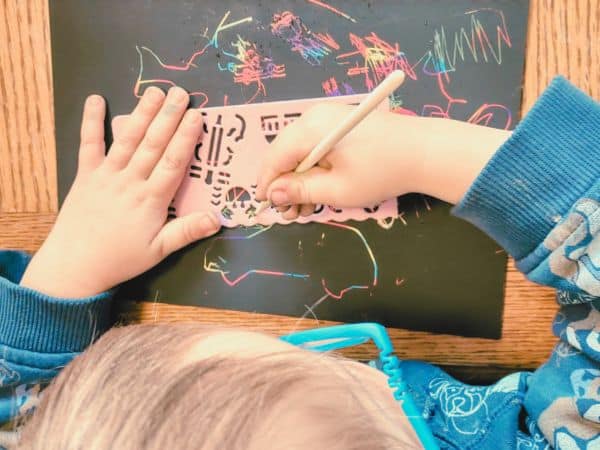
Rainbow Scratch Art
Buy rainbow scratch paper and scratch designs with a wooden stylus or paperclip to reveal brilliant colors underneath. Kids can make cards, bookmarks, or secret messages. Learning opportunity: Builds hand strength, patience, and planning skills.
Rainbow Slime
Make a big batch of clear glue slime, divide it into six portions, and tint each one a different color of the rainbow. Kids can stretch, swirl, layer, and combine them however they like. Learning opportunity: Explores polymers and non-Newtonian fluids while feeling insanely satisfying.
Shaving Cream Rainbow Prints
Spread shaving cream on a tray, drip liquid watercolors or food coloring in rainbow stripes, and lightly swirl with a toothpick. Press white paper on top, scrape off the cream, and reveal gorgeous marbled rainbows. Learning opportunity: Color mixing and basic printmaking technique.

Rainbow Pasta Necklaces
Divide pasta it into zipper bags, and dye each batch a different color with food coloring and a little rubbing alcohol. After the pasta has had time to absorb the color, dump it all onto a tray to dry. Learning opportunity: Sensory integration and color recognition.
Rainbow Baking Soda & Vinegar Fizz
Sprinkle a thick layer of baking soda in a tray and give kids pipettes filled with colored vinegar. They drip the colors wherever they want and watch fizzy rainbow eruptions appear. Learning opportunity: Acid-base chemical reaction and color blending.
Fruit Loop Rainbow Craft (and Snack!)
Draw a big rainbow arc on paper and have kids glue Fruit Loops in color order, or string them on yarn to make edible jewelry. Learning opportunity: Sorting, patterning, and fine-motor threading.
Grow a Crystal Rainbow
Twist pipe cleaners into rainbow arch shapes and suspend them in a strong borax solution overnight. Wake up to sparkling crystal-covered rainbows. Learning opportunity: Solutions, saturation, and crystal growth.

Liquid Watercolor Coffee Filter Suncatchers
Place coffee filters on a protected surface and let kids drip liquid watercolors freely with pipettes. Spritz with extra water to watch the colors bleed, then hang in the window for stained-glass rainbows. Learning opportunity: Color blending and how light shines through translucent materials.
Rainbow Wind Catcher
Cut long strips of colorful tissue paper, crepe paper, or ribbon and staple or tape them to a paper-plate ring or stick. Hang outside and watch the colors dance in the breeze. Learning opportunity: Weather observation and scissor practice.
Rainbow Handprint Keepsake
Paint your child’s hand or foot in rainbow stripes and press it onto paper or canvas. Add cotton-ball clouds and a construction-paper pot of gold for an instant heirloom. Learning opportunity: Color order and a sweet memory of exactly how tiny those hands once were.
Rainbow Ice Excavation
Layer water tinted with liquid watercolors in a large bowl or bucket, adding small toys as you go, then freeze overnight. Give kids warm water droppers, salt, and spoons to melt and rescue the treasures. Learning opportunity: States of matter and the effects of temperature and salt on ice.

Grow a Rainbow
Draw thick lines with washable markers on two sides of a paper towel. Set the paper in two bowls and watch the colors climb. Learning opportunity: Shows that most dyes are mixtures of many colors.
DIY Rainbow Kaleidoscope
Line a cardboard tube with shiny foil, add translucent pony beads or bits of colored cellophane at one end, and cover with wax paper secured by a rubber band. Look through and turn for endless rainbow patterns. Learning opportunity: Reflection and symmetry.
Real-Life Rainbow Hunt
After rain (or with a hose on mist), go outside with a spray bottle and hunt for actual rainbows in the spray, puddles, or sky. Take photos or sketch what you find. Learning opportunity: Real-world weather science and observation skills.

Nature Color Scavenger Hunt
Print or draw a simple rainbow chart and head outside with a color template. Challenge kids to find something red, orange, yellow, green, blue, indigo, and violet that occurs naturally — flowers, leaves, rocks, berries, etc., whatever Mother Nature provides that day. Learning opportunity: Color recognition, observation, classification, and a deep appreciation for the rainbow colors all around us.
Tips for Rainbow Success
Rainbow week can be one of the most joyful units of your entire year — but a little upfront planning turns “fun chaos” into “pure magic.” Here are all the practical tips I’ve gathered from years of doing these rainbow activities and others with my own kids.
- Prep your mess zone ahead of time. Lay down a cheap plastic shower-curtain liner (dollar store purchase), an old vinyl tablecloth, or even a big flattened cardboard box. Messy rainbow activities that use shaving cream, colored liquids, etc. clean up in under three minutes when everything is contained.
- Embrace the “wrong” colors. Kids often mix wildly different shades than we expect, and those muddy browns, unexpected grays, or neon surprises are usually their proudest creations. Resist the urge to correct — the real learning happens when they experiment freely.
- Photograph the experiments and crafts. Documenting is great for homeschool portfolios and to keep completed crafts to a minimum but still have the memories.
- In the same vain, gift crafts to grandparents to decrease clutter around your home. Such as, the coffee filter suncatchers make great gifts.
- Match the science talk to the child in front of you. A four-year-old is thrilled with “The light is bending and making colors dance!” while a seven-year-old might want to hear about wavelengths and prisms.
- Double or triple recipes when something is a hit. Made slime and they’re begging for more colors? Whip up another batch while the excitement is high. The same goes for dyed spaghetti — a little extra prep now means hours more play later.
- Space out the activities. Pick 1-3 favorites for a week, then swap in new ones the next week. This keeps the wonder fresh and stretches your rainbow unit across a month (or for an entire season).
- Involve older kids as “lab assistants.” Let them measure, pour, or explain the steps to younger siblings. It builds confidence, reinforces their own learning, and gives you a moment to sip coffee and take pictures.
- Keep cleanup supplies handy: a roll of paper towels, a small broom and dustpan, and a stack of damp washcloths.
- Read books about colors and rainbows throughout the entire unit study. Cuddle up for this during morning basket or before bed.
Follow even half of these tips and your rainbow activities will run smoothly, stay joyful, and leave zero resentment about the mess. You’ve got this — now go make some color magic!

Somewhere Over the Rainbow
There’s something almost beautiful about watching a child discover that light, water, and color can create pure magic. These 20+ activities are memorable, playful, and filled with hands-on learning. So open the curtains, grab whatever supplies you need, and embrace the glorious mess. Leave a comment below sharing which activity you’re most excited about setting up with your child. Happy rainbow chasing!
Recent Posts on the Blog